


A Landmark Observation
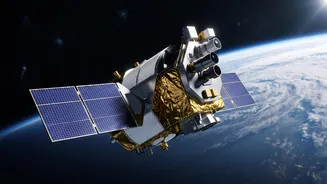
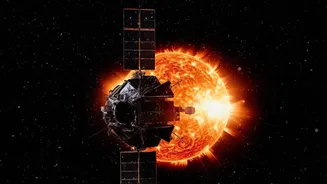
In a significant achievement for India's space program, ISRO's Aditya-L1 mission has detected early warning signs in the Sun's atmosphere. Scientists observed small, short-lived brightenings in the hours leading up to major solar flares. Crucially, these
transient events were clustered around the very locations where the larger eruptions later occurred. This breakthrough finding, which combines data from three different instruments on board, provides valuable clues into the physical processes that trigger these violent solar events. The ability to spot these precursor activities is a critical first step towards developing reliable flare forecasting.
India’s Advanced Eyes on the Sun
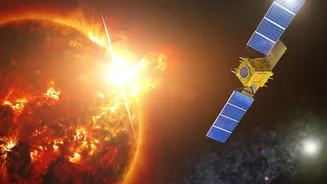
This discovery was made possible by the coordinated observations of three key instruments aboard Aditya-L1. The Solar Ultraviolet Imaging Telescope (SUIT) captured images of the Sun's lower atmosphere in near-ultraviolet (NUV) wavelengths, which are mostly blocked by Earth's atmosphere and thus can only be studied effectively from space. These SUIT observations identified the initial brightenings. Simultaneously, the Solar Low Energy X-ray Spectrometer (SoLEXS) and the High Energy L1 Orbiting X-ray Spectrometer (HEL1OS) detected X-ray signatures corresponding to these events. This combination of UV and X-ray data allows scientists to connect activity in the Sun's lower atmosphere with the massive energy release that happens in the corona above.
What Are Solar Flares?
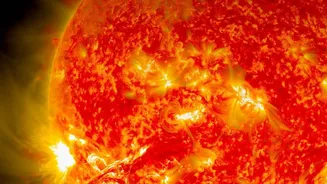
A solar flare is a sudden, intense burst of electromagnetic radiation from the Sun's surface. These eruptions happen when immense magnetic energy, built up in the Sun's atmosphere, is suddenly released. Flares are classified by their strength, much like earthquakes, with A-class being the weakest, followed by B, C, M, and X-class at the most powerful end of the scale. Each letter represents a ten-fold increase in energy output. While the radiation from a flare can't pass through Earth's atmosphere to physically harm humans on the ground, the intense energy can have significant effects.
Why Early Warnings Matter
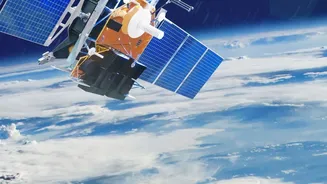
Predicting solar flares is a key goal of space weather forecasting because they can have serious consequences for our technology-dependent world. The intense radiation from a major flare can disrupt high-frequency radio communications and degrade GPS navigation systems. It poses a radiation hazard to astronauts in space and can damage the sensitive electronics on satellites that we rely on for communication, weather forecasting, and more. In extreme cases, associated events like Coronal Mass Ejections (CMEs), which sometimes accompany flares, can induce powerful electrical currents in power grids on Earth, potentially causing widespread blackouts. By detecting precursor activity, Aditya-L1 provides the potential for advance warnings that could help mitigate these impacts.
A Major Success for ISRO
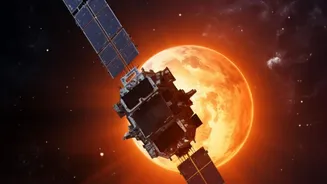
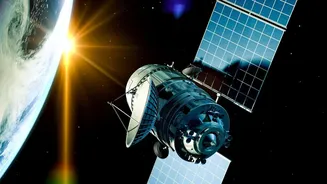
This successful detection is a major validation of the Aditya-L1 mission and its 'Made in India' instruments. Stationed 1.5 million kilometres from Earth at the Sun-Earth Lagrange Point 1 (L1), the observatory has an uninterrupted view of the Sun. This unique vantage point allows for continuous monitoring of solar activity, something impossible from the ground. While Aditya-L1 is primarily a scientific mission to understand the Sun, its observations are a significant step towards India developing its own space weather prediction capabilities. The data gathered will not only help scientists around the world understand the mysteries of our star but also enhance our ability to protect critical infrastructure on Earth and in space.