

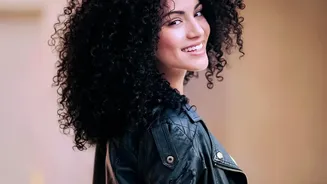
The wash-and-go promises an effortless, heat-free way to embrace your natural curls. But as many find out, the name is deceiving. A truly great result isn’t just about washing and leaving; it's about understanding your hair's unique blueprint.
The Myth of 'Effortless' Curls
The term
“wash-and-go” is one of the most misleading in haircare. It suggests a process of simply cleansing your hair and walking out the door. In reality, it’s a styling method designed to enhance your natural curl pattern with minimal manipulation, but it requires specific techniques and products. It's less about a lack of effort and more about a lack of heat or texture-altering tools. The goal is to set your natural curls while they are wet, creating definition and longevity that can last for days. The final look — be it defined ringlets, soft waves, or tight coils — is an authentic expression of your hair, but achieving that expression requires a deliberate process.
Know Your Hair's Blueprint
Before you can perfect your technique, you must understand the key characteristics of your hair. Your curl pattern, which ranges from wavy (Type 2) to curly (Type 3) to coily (Type 4), is the most visible trait. However, texture (fine, medium, coarse) and porosity (your hair's ability to absorb and retain moisture) are just as critical. For example, a heavy cream that beautifully defines coarse, high-porosity coils might weigh down fine, low-porosity waves, leaving them greasy and limp. Similarly, a lightweight gel might give fine curls the perfect hold but offer no frizz control for thicker, denser hair. Your results are a direct reflection of how well you cater to these specific needs.
The Foundation: Cleanse and Hydrate
Every successful wash-and-go starts with a clean, well-hydrated canvas. Product buildup from oils, butters, and creams can leave a film on the hair shaft, preventing your stylers from working effectively and resulting in dull, undefined curls. Start by cleansing with a hydrating, sulfate-free shampoo to remove residue without stripping essential moisture. Follow up with a conditioner that offers plenty "slip" to make detangling easier. This step is best done in the shower with your fingers or a wide-tooth comb while the conditioner is still in your hair to minimize breakage and preserve your natural curl clumps.
The Secret: Styling on Soaking Wet Hair
One of the most common mistakes is applying products to hair that is merely damp instead of soaking wet. Water is a crucial ingredient for hydration and helps your styling products distribute evenly, which is essential for defining curls and fighting frizz. For best results, apply your stylers in the shower as the last step of your routine, right after rinsing out your conditioner. Raking products through with your fingers or using the “praying hands” method to smooth them down the hair shaft ensures every strand is coated. This technique helps to seal the hair cuticle, locking in moisture and creating the smooth, defined curls you’re looking for.
Choose Your Styler Wisely
The products you choose will make or break your wash-and-go. The general rule is to layer products, starting with a leave-in conditioner for moisture, followed by a styler for hold. For fine or wavy hair (Type 2/3A), lightweight mousses, foams, or light-hold gels can provide definition without weighing hair down. For medium to thick curly hair (Type 3B/3C), curl creams can offer moisture and definition, often layered under a gel for added hold. For coily and kinky hair (Type 4), richer creams, butters, and strong-hold custards or gels are often necessary to define tight curl patterns, combat shrinkage, and seal in moisture.
The Final Set: To Air-Dry or Diffuse
Once your product is applied, it’s crucial to avoid touching your hair as it dries to prevent frizz. You have two primary options for drying: air-drying or using a diffuser. Air-drying is the most low-effort method but can take a long time and may result in less volume. Diffusing, which involves using a blow dryer on a low-speed, low-heat setting with a diffuser attachment, can speed up the process, create more volume, and enhance curl definition. Some stylists even prefer using a hooded dryer to set the style with indirect heat. The best method depends on your hair type and desired outcome, so don’t be afraid to experiment to see what works for you.