



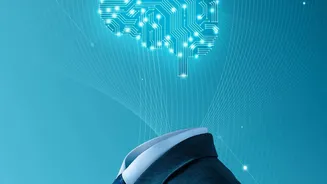

Artificial intelligence is no longer a future concept in hiring; it's a present-day reality. As companies in India and globally adopt AI to find talent faster, a critical question emerges: where do experienced professionals fit in?
The Rise of the AI Co-Recruiter
Today, AI's role in
recruitment is primarily focused on handling high-volume, repetitive tasks. Think of it as a powerful assistant. AI-powered tools can screen thousands of resumes in minutes, match candidates to job descriptions, handle interview scheduling, and even manage initial communications through chatbots. This dramatically increases speed and efficiency, allowing HR teams to process a larger pool of applicants than ever before. For many large organisations, this automation is now a baseline expectation for optimising the hiring process. In India, companies are increasingly training staff on how to use AI as a 'capability multiplier' to handle administrative workloads, freeing up human recruiters to focus on more strategic work.
The Double-Edged Sword of Efficiency
While speed is a major advantage, it comes with risks. A primary concern is algorithmic bias. If an AI is trained on historical hiring data that contains past biases, it can unintentionally perpetuate and even amplify those patterns, potentially discriminating against certain demographics. Recent studies have shown that some AI screening tools can produce demographic disparities. Furthermore, the rise of AI has created an arms race. A majority of job seekers now use AI to write or tailor their resumes, making it harder for hiring managers to verify skills and tell candidates apart. This has paradoxically increased the workload for some HR leaders, who report spending more time reviewing applications and conducting more interviews to compensate.
Why Human Judgment Remains Irreplaceable
Hiring is about more than matching keywords on a resume. This is where the wisdom of experienced staff becomes critical. Human judgment is essential for evaluating the complex qualities that AI cannot easily quantify, such as cultural fit, emotional intelligence, leadership potential, and adaptability. An experienced recruiter can read between the lines of a CV, understand the context of a career gap, or identify transferable skills from a non-traditional background that an algorithm might miss. These nuanced assessments are crucial, especially for senior and executive roles where a wrong hire can have significant consequences. Ultimately, building trust and a relationship with a candidate is a deeply human interaction that influences offer acceptance and longterm success.
Forging the 'Augmented' Recruiter
The most effective hiring models of the future won't be a battle of AI versus humans, but a partnership between them. This 'human-in-the-loop' approach treats AI as a powerful assistant, not the final decision maker. In this model, AI handles the data heavy lifting—sourcing, screening, and scheduling—while human recruiters focus on the high value tasks that require judgment and empathy. Surveys show that while talent leaders are eager to adopt AI, the vast majority of recruiters want to retain final authority over hiring decisions. This frees up HR professionals to move from administrative roles to more strategic ones, focusing on strengthening company culture, developing leaders, and ensuring the hiring process is fair and transparent.
The Outlook for India Inc.
In India, the adoption of AI in HR is accelerating rapidly. A recent report noted that while two thirds of Indian companies are deploying AI in HR, less than half have established formal rules to govern its use, highlighting a gap between adoption and maturity. This points to a critical need for human oversight. As AI becomes more embedded, concerns about fairness and transparency within India's diverse socio economic landscape are paramount. Progressive firms are focusing on role specific AI training to ensure employees see it as a collaborative tool rather than a replacement. The consensus among experts is that human oversight is crucial to audit AI tools for bias and ensure hiring decisions remain equitable.