







Buying gold in India is an act of trust. But what if that trust is challenged by a rare metal you've likely never heard of? A recent investigation in Rajasthan has put a spotlight on rhenium, raising serious questions about jewellery purity tests.
What is Rhenium and Why is it a Concern?
Rhenium
is one of the rarest elements on Earth, even rarer than gold. It's a silvery-white, incredibly dense metal with one of the highest melting points of all elements. Because of its resistance to extreme heat, its primary uses are in high-tech industries, such as making jet engine components and catalysts for petroleum refining. The concern arises from its physical properties. Rhenium's density is very close to that of gold. This means it can theoretically be mixed with gold to increase an ornament's total weight without being easily detected by simple density or weight checks, which have traditionally been a part of verifying gold's authenticity.
The Jodhpur Experiment
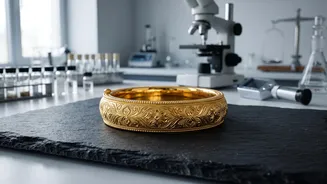
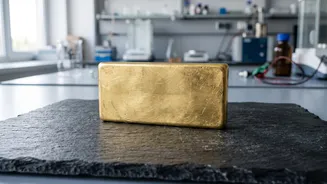
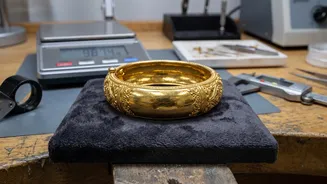
Recent reports, most notably from an investigation by Dainik Bhaskar, detailed an experiment conducted in Jodhpur to test this theory. Investigators reportedly worked with a local jeweller to mix one gram of rhenium powder with 7.83 grams of 24-karat gold. After adding other standard alloys, they crafted an ornament. The finished piece allegedly contained only 81.73% gold, which is closer to 20-karat purity. However, when this adulterated piece was taken to various testing centres and showrooms, it reportedly passed routine checks as 22-karat (91.6% purity) gold. One hallmarking centre even issued it a '916' hallmark, certifying it as 22-karat gold.
How Could Purity Tests Be Fooled?
The issue lies with the limitations of common testing methods. Traditional touchstone and acid tests are surface-level checks and can't detect heavier metals alloyed deep within an ornament. The more modern method uses X-Ray Fluorescence (XRF) machines, which are standard in most hallmarking centres and showrooms. These machines analyse the elemental composition of an object. However, their effectiveness depends on their calibration, software, and the way a test is conducted. Unless the XRF machine is specifically configured to look for rhenium, its spectral signature can be missed or misinterpreted. The metal may also be distributed unevenly, meaning a quick scan of one spot might not detect it. More advanced and destructive methods like a fire assay would reveal the true gold content, but these are not used for routine checks of finished jewellery.
What This Means for BIS Hallmarking and Consumers
For Indian consumers, the Bureau of Indian Standards (BIS) hallmark is the ultimate symbol of trust in gold purity. The mandatory hallmarking scheme, which includes a 6-digit alphanumeric Hallmark Unique Identification (HUID) code, was designed to prevent this exact kind of adulteration. The HUID system creates a traceable record for each piece of jewellery, linking it to the jeweller and the assaying centre. The Rajasthan report does not mean the hallmarking system is broken, but it does expose a potential vulnerability that needs to be addressed. It highlights that the integrity of the hallmark depends entirely on the accuracy of the test performed at the assaying centre. If a testing machine can be fooled, so can the system. Industry experts and the BIS will likely be reviewing testing protocols to ensure they can reliably detect not just rhenium, but other dense metals like tungsten, iridium, and osmium, which have also been cited as potential adulterants.
Staying Protected as a Buyer
This news can be unsettling, but it is not a reason for panic. It is an emerging concern about a sophisticated new method of fraud, not a sign that all hallmarked jewellery is suspect. For now, the best defence for a consumer remains unchanged: always buy from reputable and trusted jewellers. Ask questions about their testing processes and ensure every piece of gold jewellery you buy carries the three marks of a modern BIS hallmark: the BIS logo, the purity grade (e.g., 22K916), and the 6-digit HUID code. You can use the BIS Care app to verify the HUID and check the details of the item and the jeweller. This digital trail offers a layer of accountability that is more crucial than ever.