



A Mission's Second Act
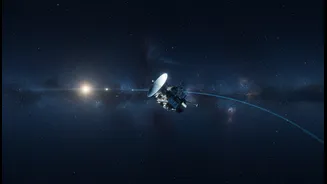
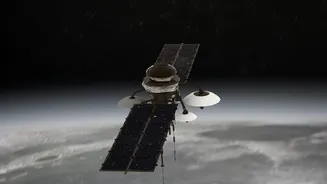
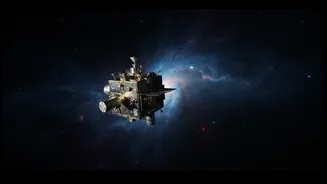
After its historic flyby of Pluto and a 2019 visit to a distant object named Arrokoth, NASA's New Horizons spacecraft is far from retired. It continues to journey through the Kuiper Belt, a remote region of icy bodies left over from the formation of the solar
system. Now in its second extended mission, the probe has a new set of objectives that are just as critical as its first: to study the vast, invisible environment of the outer solar system. This encore performance is turning the spacecraft from a planetary explorer into a deep-space sentinel, giving scientists an unparalleled view of our cosmic neighbourhood. The spacecraft is currently in a planned hibernation mode to save power but continues to collect valuable data.
The Sun’s Protective Shield
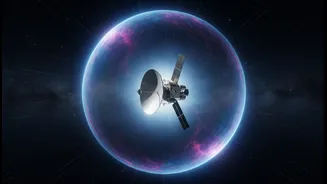
Our solar system exists within a massive bubble called the heliosphere, created by a constant stream of charged particles from the Sun known as the solar wind. This bubble extends far beyond Pluto, pushing back against the material floating in interstellar space. The heliosphere acts as a vital shield, protecting Earth and the other planets from a significant amount of dangerous galactic cosmic radiation. Without this protective barrier, life on Earth might have evolved very differently, if at all, as our planet would be constantly bombarded by high-energy particles from deep space.
Galactic Rays and Solar Winds
Galactic cosmic rays are highly energetic particles—mostly protons and atomic nuclei—accelerated to near light speed by distant supernova explosions and other violent cosmic events. They pose a significant risk to astronauts and satellite technology. The heliosphere blocks many of them, but its strength and shape are not constant. By studying the solar wind, New Horizons helps us understand this shield. Its Solar Wind Around Pluto (SWAP) instrument measures the speed and density of solar wind particles. Recent data shows the solar wind slows down significantly as it travels outward, partly due to its interaction with neutral interstellar gas that seeps into the heliosphere.
A Unique Vantage Point
New Horizons is in a unique position, billions of kilometres away, to provide a fresh perspective. It's the only spacecraft currently operating in the Kuiper Belt, and its modern instruments allow it to make measurements the pioneering Voyager probes couldn't. For instance, the Pluto Energetic Particle Spectrometer Science Investigation (PEPSSI) instrument can measure the composition and density of particles that help shape the outer heliosphere. By comparing data from New Horizons with that from the Voyager probes and missions closer to Earth, scientists can build a more complete, three-dimensional model of our Sun's domain and its interaction with the galaxy.
Rewriting the Textbooks
The data from New Horizons is already refining our understanding of our solar system's edge. Scientists have used its measurements to track a gradual slowdown of the solar wind, which was found to be 13 to 15 percent slower at 58 times the Earth-Sun distance than it is near our planet. These findings help validate models of how the heliosphere is shaped and how it protects us. The mission is also measuring the cosmic optical background—the faint, ambient light from all galaxies in the universe—providing a clearer picture than possible from within the inner solar system, which is filled with light-scattering dust. Each new measurement from this distant explorer helps piece together the complex puzzle of our place in the cosmos.