

A Cosmic Puzzle
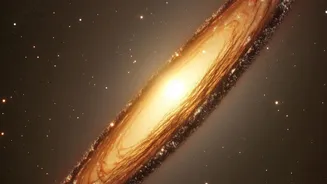
Our galaxy isn't perfectly neat. While most of its stars, including our Sun, orbit within a flat, spinning disc, the Milky Way is surrounded by a vast, sparse sphere of ancient stars called the stellar halo. For years, astronomers have been puzzled by this
halo. Observations from the European Space Agency's Gaia mission revealed that while stars in the main disc zip around the galactic centre at about 220 kilometres per second, the stars in the halo move much more slowly, at only about 25 kilometres per second. This huge discrepancy suggested something dramatic happened in our galaxy's past to throw things off-kilter. The halo stars are relics from the Milky Way's formation, and their strange, slow dance held the key to a long-forgotten secret.
The Prime Suspect
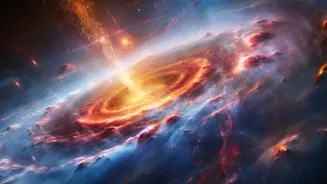
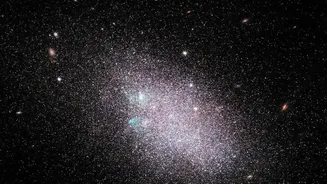
The culprit, according to researchers at Durham University, was a massive dwarf galaxy that crashed into a young Milky Way around 10 billion years ago, long before our solar system existed. This smaller galaxy has been nicknamed Gaia-Sausage-Enceladus, or simply the 'Gaia Sausage', because of the elongated, sausage-like shape of its stars' orbits after the collision. This wasn't a minor fender-bender; it was a head-on cataclysm. Though classed as a 'dwarf', the Gaia Sausage was immense, containing stars, gas, and dark matter with a mass more than 10 billion times that of our Sun. The evidence for this ancient crash first came to light in 2018, when astronomers traced the odd, plunging orbits of some halo stars back to a single, shredded intruder.
Recreating a Galactic Crash
To test their theory, the Durham team turned to powerful supercomputer simulations. Using facilities like the DiRAC COSMA8 supercomputer, they modelled how Milky Way-like galaxies evolve over billions of years. They were specifically looking for a mechanism that could explain the halo's strangely slow rotation. The simulations showed that when a large galaxy like the early Milky Way experiences a direct, head-on collision with a massive satellite like the Gaia Sausage, a remarkable event can occur: a 'disc flip'. It's important to remember that galaxies aren't solid objects. The 'flip' isn't like flipping a coin; rather, the immense gravitational shockwave from the impact gradually but completely reorients the entire spinning disc of stars over hundreds of millions of years.
The Verdict: A Tilted Galaxy
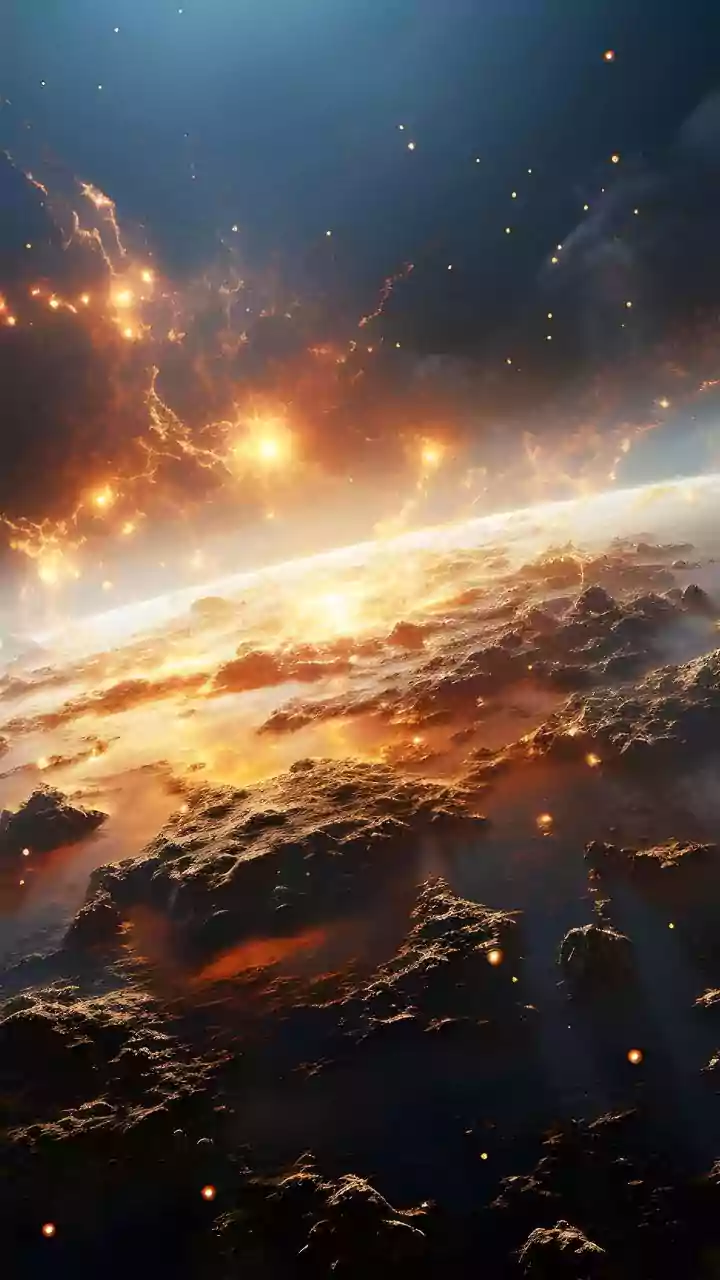
The simulations provided the smoking gun. The models that included a massive, head-on collision resulted in galaxies with slowly rotating halos—just like our own. The impact from the Gaia Sausage didn't just add new stars to our galaxy; it fundamentally reshaped it. The Milky Way's powerful gravity tore the smaller galaxy to shreds, and its stars were strewn throughout what is now the stellar halo. The immense gravitational energy transfer from this merger was enough to knock the entire galactic disc by more than 90 degrees, leaving it in the orientation we see today. The collision, in essence, created the conditions for the slow-moving halo and the tilted disc we observe, solving two cosmic puzzles at once.
Why This Cosmic History Matters
This discovery does more than just add a dramatic chapter to our galaxy's life story. It reinforces the modern understanding that galaxies are not static, isolated islands of stars but are constantly evolving, dynamic structures. They grow and change through violent mergers and acquisitions, a process sometimes called 'galactic cannibalism'. In fact, other, smaller collisions have happened since and are still happening. The Sagittarius dwarf galaxy, for example, has passed through the Milky Way's disc multiple times, with each passage potentially triggering bursts of star formation—one of which may have even helped kick-start the formation of our own Sun. By piecing together this violent history, astronomers can build a more complete picture of how structures like our own galaxy came to be, providing crucial context for our place in the universe.