






The Final, Fiery Descent
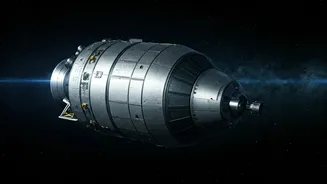
Getting into orbit is only half the battle; returning is arguably the harder part. The Gaganyaan crew module, carrying India's first astronauts, will re-enter Earth's atmosphere at a blistering speed of nearly 28,000 kilometres per hour. At this velocity,
the capsule is a fiery projectile, and its kinetic energy must be safely dissipated. The primary brake is the atmosphere itself, which will scrub off most of the speed through aerobraking. However, for the final and most delicate part of the journey, slowing from hundreds of kilometres per hour to a gentle splashdown, the mission's success and the crew's lives depend on a robust and redundant parachute system.
A Symphony of Ten Parachutes
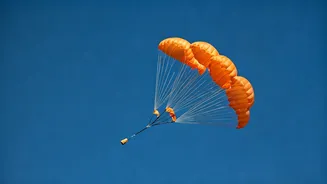
The recovery isn't as simple as just pulling a single ripcord. ISRO has engineered a multi-stage deceleration system involving ten parachutes of four different types, each with a specific job. The sequence begins with two apex cover separation parachutes, which are small but essential for jettisoning the protective cover of the main parachute compartment. Next, two drogue parachutes deploy. These are designed to stabilise the fast-moving capsule, preventing it from tumbling, and to provide the first major stage of deceleration.
From Drogues to Mains
Once the drogue parachutes have done their job and are released, the main event begins. Three pilot parachutes are deployed. Their sole purpose is not to slow the capsule, but to pull the three massive main parachutes from their housing. These main chutes are the workhorses of the system, designed to dramatically slow the crew module to a velocity safe for splashdown in the Indian Ocean. This carefully choreographed sequence ensures that each stage of deployment happens under controlled conditions, preventing catastrophic tangling or structural failure.
Redundancy: The Ultimate Safety Net
So, why ten parachutes? The answer lies in the engineering principle of redundancy. While all three main parachutes are intended to deploy, the system is designed to bring the crew module to a safe splashdown speed with just two of the main parachutes functioning. The third main parachute acts as a crucial backup, providing an essential safety margin in case one fails to open correctly. This layered approach, with multiple systems and backups, is central to the human-rating process for Gaganyaan. It demonstrates ISRO's absolute commitment to astronaut safety, where every conceivable failure mode must be accounted for and mitigated.
Tested to the Absolute Limit
This complex system is not being left to chance. ISRO, in collaboration with DRDO, has been conducting a relentless series of tests to validate every component. These include airdrop tests using IL-76 aircraft to drop dummy masses equivalent to the crew module, rail-track rocket sled tests to check deployment at high speeds, and integrated tests simulating various failure scenarios. Recent tests have successfully validated the drogue parachutes and demonstrated the system's robustness even when simulating asymmetric deployment conditions. ISRO has even developed a new Sub-Orbital Launch Vehicle for Experiments (SOLVE) specifically to test the parachute system in realistic, high-altitude conditions.