




A Cosmic Recipe's Key Ingredient
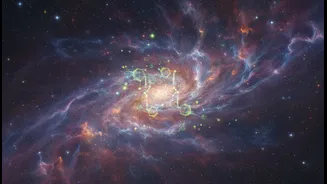
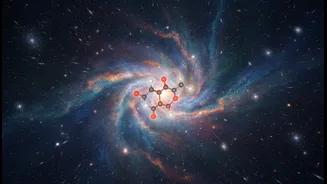
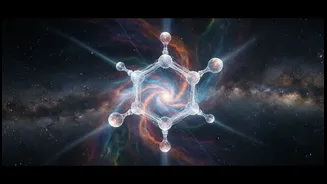
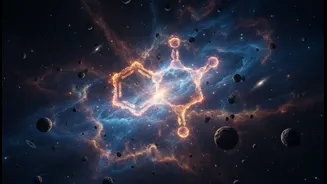
In a significant breakthrough for astrobiology, a team of researchers led by Víctor M. Rivilla at Spain's Center for Astrobiology (CAB) has detected a molecule named ethanolamine in a giant cloud of gas and dust near the center of our Milky Way galaxy.
This isn't just any molecule. Ethanolamine is a crucial component of phospholipids, the compounds that form the outer wall, or membrane, of every living cell on Earth. Finding it floating in the vacuum of space provides compelling evidence for a long-held theory: that the building blocks of life didn't necessarily originate on Earth, but may have been delivered to our young planet from the cosmos. This discovery changes the picture, suggesting the molecule forms efficiently in space and was later incorporated into the asteroids and comets that helped shape our solar system.
The Galactic Cradle
The molecule was found in a sprawling, chaotic area known as Sagittarius B2 (Sgr B2), a giant molecular cloud located just a few hundred light-years from the supermassive black hole at the heart of our galaxy. This region is a stellar nursery, one of the most massive and active star-forming zones in the entire Milky Way. It's a chemically rich, dense environment where countless molecules swirl, collide, and combine on the surfaces of icy dust grains. Using powerful radio telescopes in Spain and Germany, the scientists were able to tune into the specific radio frequencies—the unique rotational 'fingerprint'—emitted by ethanolamine molecules as they tumble through the interstellar gas. This method allows astronomers to identify specific chemical compounds from tens of thousands of light-years away.
The Prebiotic Connection
So, why is ethanolamine so important? In the complex puzzle of how life began, one of the biggest questions is how the first cells formed. A cell needs a container to hold its vital components, like genetic material and metabolic machinery, together. Phospholipids, with ethanolamine forming a key part of their 'head' group, are perfect for this job. They naturally assemble into a barrier—a cell membrane—that separates the inside of a cell from the outside world. The discovery of ethanolamine in space strongly suggests that this vital ingredient for cell walls was available in the cosmic soup from which our solar system was born. Before this, while ethanolamine had been found in meteorites, scientists suspected it might have formed within the space rocks themselves. This new finding shows it was likely created in interstellar space first, then delivered to Earth by comets and meteorites during the early, chaotic period of planetary formation.
From Space Dust to Life
This discovery fits into a broader picture that astrobiologists are piecing together. Our galaxy is a vast chemical factory. The same molecular cloud where ethanolamine was found, a region known as G+0.693-0.027, has also revealed other prebiotic molecules, including nitriles and sugars, which are precursors to RNA, DNA, and amino acids. The Spanish-led team and their international collaborators are demonstrating that the interstellar medium is a surprisingly efficient factory for creating complex organic molecules. These molecules are the fundamental chemical feedstock for life. Finding them spread across the galaxy implies that the ingredients needed for life to emerge aren't unique to our corner of the universe. They are likely available for any new planetary systems forming under the right conditions. This bolsters the idea that life might not be such a rare phenomenon in the cosmos.