

A New Look at Our Star
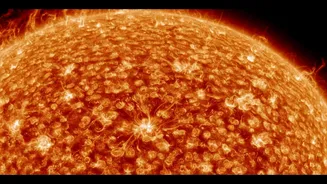
Scientists have released the highest-resolution image ever taken of the Sun's surface in visible light, and it is even more dynamic than previously imagined. Captured by the National Science Foundation's Daniel K. Inouye Solar Telescope in Hawaii, the image zooms
in on a magnetically active region near a sunspot. The picture, in which NASA scientists played a key role in analysis, reveals the Sun's 'surface' — a layer called the photosphere — not as a smooth ball of fire, but as a textured, boiling expanse of plasma. The level of detail is staggering, allowing researchers to see structures as small as 19-20 kilometres across. This achievement is akin to being able to distinguish a coin from 180 kilometres away.
What Are Solar Granules?
The captivating pattern seen in the image is called granulation. The entire surface of the Sun is covered in about four million of these 'granules' at any given time. Think of it like a giant, fiercely boiling pot of water. Each granule is a convection cell, where hot plasma from the Sun's interior rises to the surface in the bright, hot center. As it reaches the surface, it spreads out, cools, and then sinks back down along the darker, cooler lanes at the edges. These are not small bubbles; a typical solar granule is about 1,500 kilometres across — roughly the size of Texas or the country of France — and lasts for only about 8 to 20 minutes before dissipating and being replaced by a new one.
Unlocking a Solar Secret
What makes this new image so revolutionary is what it reveals at the edges of these granules. For the first time, scientists have clear, direct evidence of a phenomenon known as the Kelvin-Helmholtz instability (KHI). This occurs when two fluids, or in this case plasmas, flow past each other at different speeds, creating a shear that grows into swirling vortices, like breaking waves or patterns in Earth's clouds. While long predicted by theory to exist on the Sun, telescopes were never powerful enough to see them. These newly spotted plasma whirlpools demonstrate how processes at the smallest visible scale can significantly shape the nature of our entire star.
Solving a Million-Degree Mystery
The discovery of these tiny vortices could be the key to solving one of solar physics' most persistent puzzles: the coronal heating problem. The Sun's surface is a scorching 5,500 degrees Celsius, but its outer atmosphere, the corona, is inexplicably hundreds of times hotter, reaching over a million degrees. This defies simple logic, as temperatures should decrease further from a heat source. Scientists now theorise that the energy transported by these newly-observed Kelvin-Helmholtz instabilities could be a major contributor to this extreme heating. By studying how these swirls twist magnetic fields, researchers hope to understand how energy is channelled and released into the Sun’s upper atmosphere.
Why It Matters on Earth
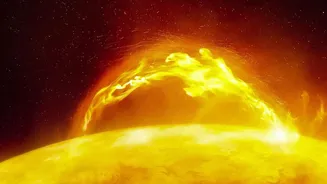
Understanding the fundamental physics of the Sun is more than just an academic exercise. The same magnetic energy that heats the corona also powers solar flares and coronal mass ejections. These eruptions create 'space weather' — powerful bursts of radiation and charged particles that can travel towards Earth. Severe space weather has the potential to disrupt our satellites, damage power grids, and interfere with GPS and communication systems. By getting a clearer picture of the mechanisms that drive solar activity, right down to the smallest scales, scientists can improve their models and provide better forecasts for potentially hazardous space weather events, helping to protect our technology-dependent world.