








The Shadow of Tradition
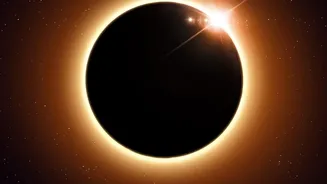
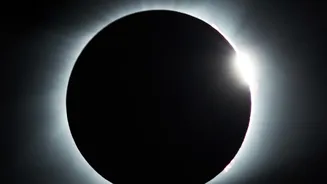
In Hindu tradition, a solar eclipse, or Surya Grahan, is far more than an astronomical alignment; it is an event laden with spiritual significance, often viewed as inauspicious. This belief is rooted in the Puranic legend of Samudra Manthana, where the demon
Svarbhanu (later known as Rahu) is beheaded by Vishnu after illicitly drinking the nectar of immortality. As vengeance, Rahu's immortal head is said to periodically swallow the sun or moon, causing an eclipse. This mythological event ushers in a period of ritual impurity known as 'Sutak,' which begins 12 hours before a solar eclipse. During Sutak, many households refrain from cooking, eating, or drinking. Temple doors are closed, pregnant women are advised to stay indoors to protect their unborn children, and any food prepared beforehand is often discarded. The core idea is that the absence of sunlight increases negative energies and impurities, making it a time for spiritual caution, prayer, and introspection rather than worldly activities.
The Rise of Eclipse Chasers
In stark contrast to these age-old customs, a parallel culture of 'astro-tourism' or 'eclipse chasing' has firmly taken root. For these individuals, a solar eclipse is a celestial bucket-list item. Tour operators and local entrepreneurs now market eclipse events, especially for rare total or annular eclipses. Hotels in prime viewing locations are booked months, sometimes years, in advance, often at soaring rates. These events often transform into festivals, combining science lectures with gastronomy and music, turning the astronomical occurrence into a full-fledged cultural immersion. Science communicators and astronomy clubs play a pivotal role, setting up telescopes in public spaces, distributing protective eyewear, and educating people on the science behind the spectacle. Their goal is to counter superstition with scientific understanding, encouraging people to witness the marvel safely instead of staying indoors.
An Uneasy Coexistence
The clash is not one of open conflict but of two worlds operating on parallel tracks. On the day of an eclipse, a city might see its temples shuttered and streets quiet in one neighbourhood, while just a few kilometres away, a vibrant gathering of tourists and locals armed with solar-filter glasses cheers as the moon obscures the sun. This dichotomy highlights a unique aspect of modern India, where ancient beliefs continue to guide the daily lives of millions, even as a globally connected, science-curious generation emerges. The economic argument for tourism is potent. As seen with eclipse events in Europe and the US, a few minutes of totality can trigger a significant influx of tourists and revenue. Proponents argue that with better infrastructure and planning, India could similarly capitalize on its celestial events, transforming them into premium travel experiences in places like Ladakh or Varanasi.
Looking to the Next Shadow
This cultural tug-of-war is set to play out again soon. While India will miss the major total solar eclipse of August 2026, which will be visible over parts of Europe, skywatchers are already preparing for the next significant event. On August 2, 2027, a partial solar eclipse will be visible across India, offering another opportunity for both tourism and tradition to stake their claim. It will be a major total eclipse over parts of North Africa and the Middle East, dubbed the “Eclipse of the Century” for its exceptionally long duration of totality. As tour companies plan viewing parties and science centres prepare educational outreach, countless others will mark their calendars for a different reason: to observe the rituals of Sutak, to fast, pray, and wait for the sun's reassuring return.