


Not Fire, Not a Rainbow
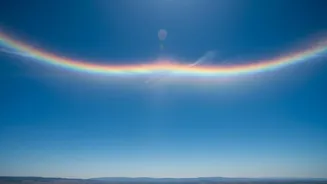
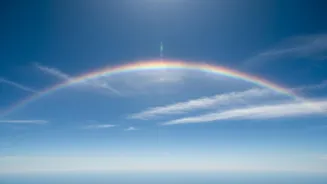
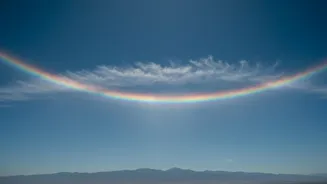
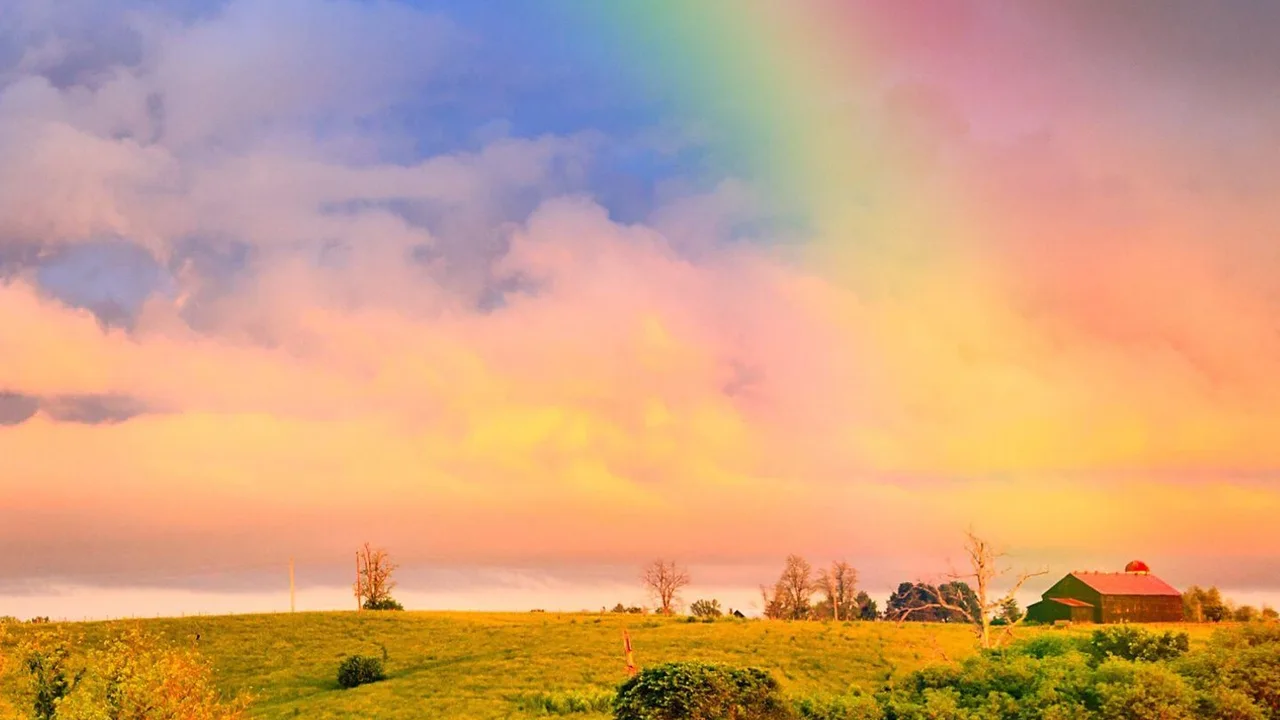
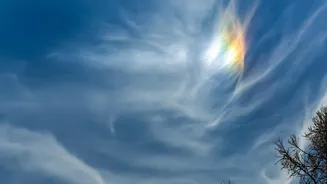
First, let's clear the air. The phenomenon known as a 'fire rainbow' has nothing to do with fire, and it isn't a rainbow in the traditional sense. The captivating name comes from its flame-like appearance and vibrant colors. Its scientific name is a circumhorizontal
arc. Unlike a true rainbow, which is formed by the refraction and reflection of light in raindrops, a circumhorizontal arc is an optical phenomenon caused by ice crystals. A recent image shared by NASA as its Astronomy Picture of the Day has brought this stunning atmospheric display back into the spotlight, showcasing a particularly vivid example seen over West Virginia.
The Science of Ice and Light
For a fire rainbow to appear, a very specific set of conditions must be met. First, the sun must be very high in the sky, at an elevation of at least 58 degrees above the horizon. This is why the phenomenon is more common in mid-latitudes during the summer months and cannot be seen at all in locations above 55 degrees latitude. Second, the sky needs to contain high-altitude cirrus or cirrostratus clouds. These wispy clouds are composed of tiny, plate-shaped hexagonal ice crystals. For the effect to work, these millions of ice crystals must be aligned horizontally, acting like tiny floating prisms. Sunlight enters a vertical face of the crystal and exits through the bottom horizontal face, bending the light and splitting it into a brilliant spectrum of colors that appears parallel to the horizon.
The Other 'Fire' NASA Studies
While the fire rainbow is a beautiful illusion of light and ice, the headline's mention of 'actual flames' opens a door to another fascinating area of NASA's research: combustion science. The agency is deeply invested in understanding the fundamental nature of fire. This research is crucial for developing more efficient propulsion systems for rockets and aircraft, and for improving fire safety for astronauts in space and for all of us here on Earth. By studying how flames behave in microgravity, for instance, scientists can uncover aspects of combustion that are masked by gravity's effects on our planet.
Seeing the Unseen in Flames
To scrutinize actual flames, NASA employs advanced imaging techniques that are just as visually striking as a fire rainbow. One such method is called Schlieren imaging. This technique, which dates back to the 19th century, visualizes differences in air density as patterns of light and shadow. When applied to flames or supersonic jets, it reveals the invisible shockwaves and the complex mixing of hot gases, which are impossible to see with the naked eye. By capturing images of these phenomena, sometimes using the sun as a background light source, engineers can gather critical data to design quieter supersonic aircraft and more stable, efficient engines. These images, though scientific in nature, possess their own abstract beauty, turning the physics of flow and combustion into art.