




Morocco: The Sands of Troy
Production for 'The Odyssey' began in the stunning landscapes of Morocco. The historic fortified village of Aït Benhaddou, a UNESCO World Heritage site, was transformed into the legendary city of Troy. Its ancient, earthen-clay buildings and labyrinthine
alleys provided the perfect setting for the film's chaotic and fiery depiction of the city's fall. Director Christopher Nolan utilized this location to create a massive, 360-degree set, lending a palpable sense of reality to the epic's opening act. Additionally, the coastal city of Essaouira, with its formidable sea walls, was used for scenes involving the infamous Trojan Horse, adding to the authentic, ancient-world feel.
Greece: Homeland of Heroes
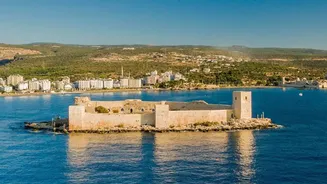
It’s impossible to tell a Greek epic without setting foot in Greece itself. The production team spent considerable time in the Peloponnese region, using its ancient fortresses and dramatic coastlines to build the world of Odysseus. Locations like Methoni Castle, a stunning fortress on a peninsula overlooking the Ionian Sea, were used to represent the kingdoms of the era, such as Sparta. The iconic Voidokilia Beach, with its perfect horseshoe shape, served as the backdrop for the 'Island of the Cyclopes'. Nearby, Nestor's Cave, a site steeped in its own mythology, also features in the film, further blurring the line between Homer's tale and Greece's real, tangible history.
Italy: Islands of Myth and Majesty
Italy’s Sicilian islands provide some of the film's most visually arresting scenes. Favignana, the largest of the Egadi Islands, was a major base for the production. The imposing Castello di Santa Caterina, a historic fortress perched high above the main town, was chosen as the location for Penelope's palace in Ithaca, where she awaits Odysseus's return. Filming also took place across the volcanic Aeolian Islands, including Lipari and Vulcano. These dramatic, rugged landscapes were used to depict the mythical floating island of Aeolia, the home of the keeper of the winds.
Scotland: The Sorceress's Lair
In a departure from sunny Mediterranean climes, the production headed to the moody coast of Scotland to create the island of the sorceress Circe. The dramatic, windswept ruins of Findlater Castle, perched on a cliff overlooking the North Sea, provided the perfect eerie atmosphere for Circe’s stronghold. The surrounding pine woodlands of Culbin Forest were also used for battle sequences, with the rugged Scottish landscape adding a raw and primal feel to Odysseus’s perilous encounters. This unexpected choice highlights the production's commitment to finding unique and authentic locations to tell its story.
Malta: A Mediterranean Haven
While much of the action happens on land, the Mediterranean island of Malta played a crucial role in the film's maritime sequences. The island nation has long been associated with Ogygia, the island of the nymph Calypso, in Homer's original poem. For Nolan's film, the coast was used for many open-water scenes. More specifically, the world-renowned water tanks at Malta Film Studios were utilized for underwater photography and complex close-range ocean battles, allowing for controlled and dramatic filming of the hero's struggles at sea.