

A Tale of Two Planets
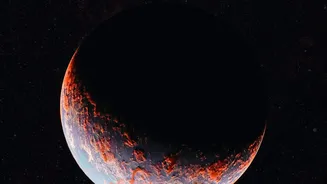
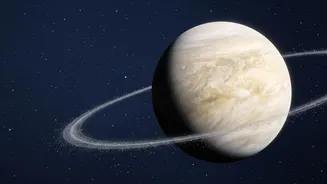
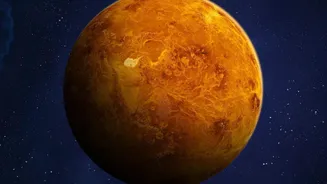
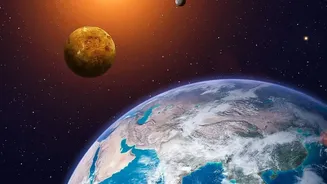
For scientists, Venus is a fascinating puzzle. It's our closest planetary neighbour and shares a similar structure to Earth, yet it’s a hellscape with crushing pressure and surface temperatures hot enough to melt lead. Another key difference has long
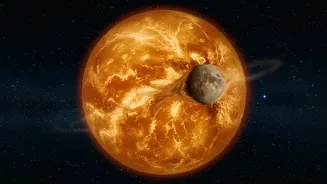
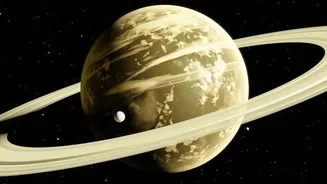
baffled astronomers: while Earth has a large, stable moon, Venus is solitary. Previous theories suggested a massive impact might have destroyed a Venusian moon, or that one simply never formed. But recent computer simulations from astrophysicist Stephen Kane at the University of California, Riverside, propose a more intimate kind of destruction—one that required no external catastrophe.
The Slow Spin of Doom
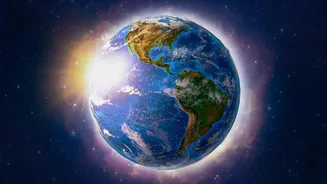
The fate of a moon is closely tied to its planet's rotation. Earth spins relatively quickly, completing a rotation every 24 hours. This transfers rotational energy to our Moon, causing it to slowly drift away from us at a rate of about four centimetres per year. Venus is the complete opposite. It has an incredibly sluggish rotation, taking 243 Earth days to complete a single spin. According to the new simulations, this slow spin creates a fatal gravitational relationship. Instead of pushing a moon away, the tidal forces exerted by a slowly rotating Venus would pull a hypothetical moon inward, causing it to spiral closer and closer to the planet.
Simulating a Cosmic Crash
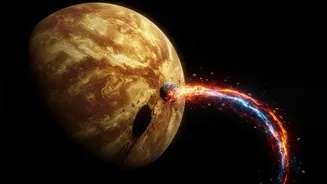
To test this idea, researchers ran a series of computer models. They first validated their simulations by accurately reproducing the current evolution of the Earth-Moon system. They then applied the model to Venus, testing scenarios with various initial rotation speeds and hypothetical moons of different sizes, from half to ten times the mass of our own. The results were surprisingly consistent. In almost all scenarios, the moon's orbit would decay, and it would eventually crash into Venus. The simulations showed that more massive moons would have been destroyed even faster, unable to escape the planet's gravitational pull. The study doesn't prove Venus definitely had a moon, but it strongly suggests that if one ever existed, it was doomed from the start.
What Would a Moon Crash Do?
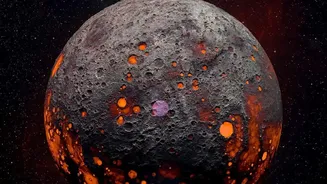
The impact of a moon colliding with Venus would have been cataclysmic, delivering an enormous amount of energy and momentum. Such an event could have profoundly altered the planet's geology, climate, and even its rotation. Some scientists speculate that long ago, Venus may have been a much more temperate world, perhaps even with liquid water oceans. A massive moon impact could have been a critical turning point, potentially contributing to the loss of water and triggering the runaway greenhouse effect that makes Venus so inhospitable today. This theory provides a potential explanation for how Earth's twin took such a dramatically different evolutionary path.
Searching for the Ghost of a Moon
Finding direct physical evidence of a billion-year-old collision is incredibly difficult. Venus underwent a massive global resurfacing event around a billion years ago, which likely erased any craters or surface debris from such a crash. However, clues might be hidden elsewhere. Scientists suggest that chemical traces could remain in Venus's dense atmosphere or that evidence of the impact might be detectable deep within the planet's mantle, similar to structures on Earth thought to be remnants of the collision that formed our own Moon. Future missions to Venus could potentially test for these atmospheric or seismic signatures, offering a chance to finally solve the mystery of the planet's lost moon.