

Cosmic Lighthouses in the Dark
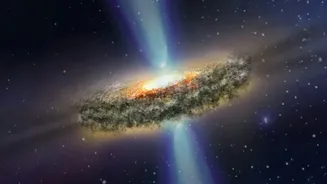
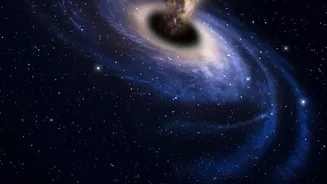
To understand this discovery, we first need to talk about quasars. Think of them as the universe's most powerful lighthouses. A quasar isn't a star, but the intensely bright core of a very distant, young galaxy. At the heart of this core is a supermassive
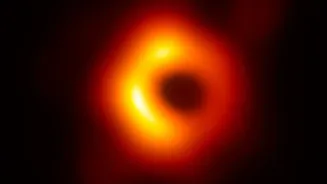
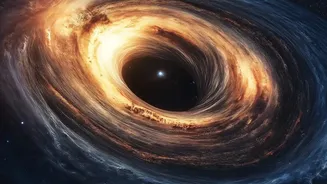
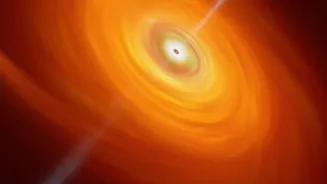
black hole, millions or even billions of times the mass of our sun, that is actively feeding on a surrounding disc of gas and dust. As this material spirals inward, it heats up to incredible temperatures and releases a staggering amount of energy, creating a beacon of light so powerful it can be seen from across the universe. This gives astronomers a unique opportunity to study the chaotic conditions of the early cosmos.
Fingerprinting the Universe
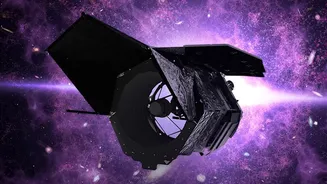
The JWST can't see these ancient black holes directly. Instead, it uses a technique called spectroscopy. By passing the light from a distant object like quasar J0148-4214 through an instrument called a spectrograph, astronomers can spread that light out into its constituent colours, like a rainbow. Embedded in this rainbow are specific bright or dark lines, which act as a chemical fingerprint, revealing what elements are present. But these lines hold another secret: they can also tell us how fast the gas that emitted the light is moving. This is the key to understanding the environment around a black hole.
The Broad-Line Region
Close to a quasar's central black hole lies a turbulent swirl of gas clouds moving at incredible speeds, whipped around by the black hole's immense gravity. This area is known as the Broad-Line Region, or BLR. Because the gas is moving so chaotically—some of it hurtling towards us, some away—the spectral lines it emits get smeared out, or 'broadened', by the Doppler effect. Spotting a BLR is like finding a black hole's calling card; it's a clear sign of a supermassive black hole actively feeding. Normally, astronomers expect to find one BLR at the center of a quasar galaxy.
An Unexpected Cosmic Trio
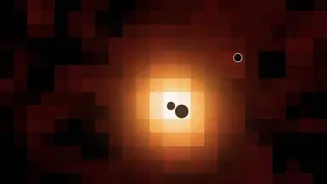
This is what makes the discovery at J0148-4214 so remarkable. Using its powerful NIRSpec instrument, the JWST didn't just find one broad-line region; it found three distinct ones within the same system. This provides the first clear evidence of three actively feeding supermassive black holes in a single galaxy in the distant universe. Two of the black holes are huddled close together near the galactic center, separated by only about 620 light-years, while a third is located further out. Their masses are estimated to be around 80 million, 2 million, and 600,000 times that of our sun.
A Portrait of Galactic Chaos
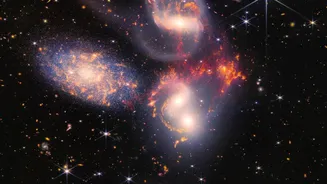
Finding three active black holes together paints a vivid picture of galaxy formation. This isn't one galaxy with three black holes; it's likely a snapshot of a chaotic merger between three separate galaxies, each bringing its own central black hole to the party. We are witnessing galaxy assembly in real time, viewing it as it happened over 12.5 billion years ago, when the universe was just a toddler. This observation strongly suggests that the early universe was a violent place, where galaxies frequently collided and merged, building up the larger galaxies we see today.
Solving a Growth Spurt Mystery
This discovery also helps answer a long-standing cosmic puzzle: how did supermassive black holes get so big, so fast? While black holes can grow by slowly sipping on gas, that process might be too slow to explain the giants seen in the early universe. This finding suggests that mergers provide a 'fast track' for growth. When galaxies collide, their black holes eventually sink to the center and merge, combining their mass in a relatively short period. The J0148-4214 system shows us the prelude to this process, a mechanism that could explain the rapid growth of these cosmic titans.