



India’s pioneering solar mission, Aditya-L1, is delivering revolutionary insights into the Sun. By merging data from its advanced coronagraph with sophisticated 3D modelling, scientists are seeing our star in a completely new dimension.
Aditya-L1: India's Eye on the Sun
Launched in September
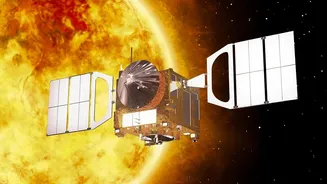
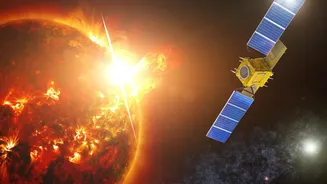
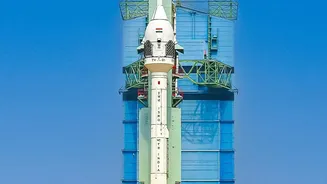
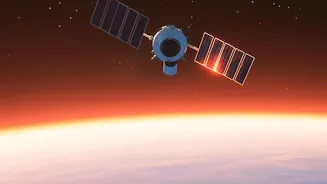
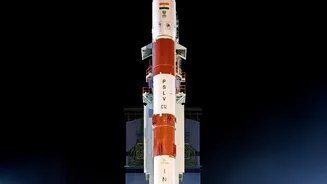
2023, Aditya-L1 is India's first dedicated space-based solar observatory. After a journey of about 1.5 million kilometres, it settled into a halo orbit at Lagrange Point 1 (L1) in January 2024. This strategic position gives it an uninterrupted view of the Sun, allowing it to act as a crucial sentinel for solar activity. The mission's primary goal is to study the Sun's upper atmosphere—the chromosphere and corona—and to observe phenomena like solar flares and Coronal Mass Ejections (CMEs), which are massive bursts of solar plasma that can impact Earth. Equipped with seven distinct payloads, Aditya-L1 is designed to provide critical data for understanding and forecasting space weather.
Seeing the Sun's Secretive Crown
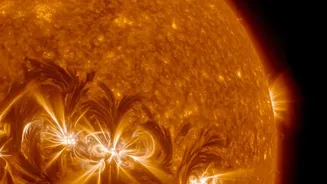
The Sun's outermost layer, the corona, is a million-degree-hot enigma. It's usually invisible, completely outshone by the bright solar disk. We only get a natural glimpse of it during a total solar eclipse. This is where a coronagraph comes in. It's a special telescopic instrument that creates an artificial eclipse by blocking the Sun's direct light with an internal mask. Aditya-L1's primary payload is the Visible Emission Line Coronagraph (VELC), a highly advanced instrument developed by the Indian Institute of Astrophysics. VELC is designed not just to image the faint corona but also to study it using spectroscopy, which analyzes the properties of its light.
From Flat Pictures to a Dynamic 3D View
A standard coronagraph gives us a two-dimensional, or 'flat', image of the Sun's corona. While useful, it's like trying to understand a complex sculpture from a single photograph. It shows movement across the sky but can't directly measure how fast plasma is moving towards or away from us. This is the challenge that the Aditya-L1 team has overcome. By using VELC's spectroscopic capabilities, scientists can measure the 'Doppler shift' in the light from the corona's plasma. This shift reveals the plasma's velocity along our line of sight, adding the crucial third dimension of depth and motion. This data is then fed into powerful computer models to reconstruct the full 3D geometry of solar events.
A Breakthrough in Solar Science
The combination of realtime coronagraph data and 3D modelling has already led to a groundbreaking discovery. Scientists have found that Coronal Mass Ejections (CMEs) do not expand uniformly like a symmetric bubble, which was the longheld assumption. Instead, they expand unevenly and develop an asymmetric shape as they leave the Sun. This was revealed by analysing the Dopplershifted light captured by VELC, which showed plasma moving both towards and away from the observer during an eruption. A model based on a symmetric explosion couldnt replicate this pattern, but a model featuring an uneven, asymmetric expansion did. This finding fundamentally changes how we understand the early evolution of these powerful solar storms.
Why This Matters for Us on Earth
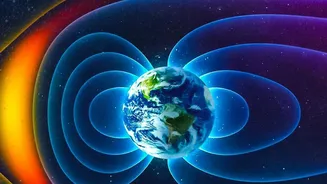
This isn't just an academic achievement; it has profound realworld implications. Understanding the true shape and expansion of a CME is critical for improving space weather forecasting. Solar storms can disrupt satellite operations, GPS navigation, and communication networks, and in severe cases, even damage power grids on Earth. Previously, flawed models based on symmetric eruptions could lead to inaccurate predictions about whether a CME would hit Earth and when. By providing a more accurate 3D view of how these events unfold, AdityaL1's data will lead to more reliable and timely space weather alerts. This allows us to better protect our critical infrastructure in space and on the ground, showcasing a significant contribution by India to global space research.