






Meet the Microblazar
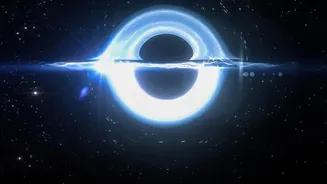
First, let's break down the terminology. You may have heard of blazars, which are among the most energetic phenomena in the universe. They occur when a supermassive black hole at the centre of a galaxy feeds on surrounding gas and dust, blasting out two
powerful jets of particles and radiation. When one of these jets happens to point directly at Earth, we call it a blazar. For decades, astronomers have theorised that a smaller version should exist: a 'microblazar'. Instead of a supermassive black hole, a microblazar is powered by a stellar-mass black hole, just a few times the mass of our sun, which is feeding on a companion star. After a search spanning over 30 years, astronomers believe they have finally found the most convincing candidate.
The Curious Case of IRAS 18293-0941
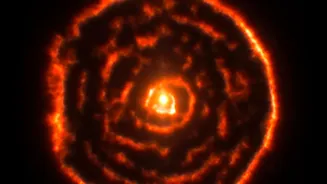
The object at the heart of this discovery is named IRAS 18293-0941. Located about 12,000 light-years away in our own Milky Way galaxy, it's a binary system where a black hole, roughly 10 times the mass of our sun, orbits a giant, hot star every 11 days. The black hole's immense gravity strips material from its stellar companion. While much of this material is consumed, some is channelled into two violent jets of plasma that rocket into space at about 75% of the speed of light. What makes this system so special is its orientation. An international team of researchers confirmed that one of these jets is aimed almost directly at us, the key characteristic of a microblazar.
Hiding in Plain Sight
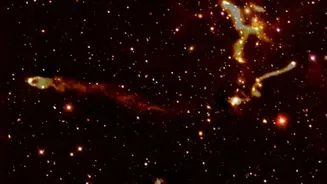
If this object is so powerful, why has it taken so long to find? The system was first catalogued back in 1983, but it remained largely forgotten because it's shrouded by a thick veil of interstellar dust, making it practically invisible to optical telescopes. To piece the puzzle together, astronomers had to combine data from an array of powerful instruments, including the MeerKAT radio telescope in South Africa and the European VLBI Network. These radio observations allowed them to peer through the dust and detect the tell-tale signs of a one-sided jet, which appears brighter due to an effect called relativistic beaming. Essentially, because the jet is moving towards us at such high speed, its light is amplified, making it stand out.
A Cosmic Laboratory in Our Backyard
While the idea of a plasma jet aimed at Earth sounds alarming, scientists have confirmed there is no danger. At 12,000 light-years away, IRAS 18293-0941 is a subject of intense scientific interest, not a threat. The discovery is thrilling for astronomers because it provides a relatively close-up 'cosmic laboratory'. Blazars are billions of light-years away, making them difficult to study in detail. A microblazar in our own galaxy allows scientists to observe the physics of how black holes accelerate particles and launch these incredible jets on a much smaller, faster timescale. It could help solve long-standing mysteries, such as the origin of some ultra-high-energy cosmic rays that constantly bombard Earth. Although some questions remain—the system has not yet shown the rapid variability in brightness that theory predicts—it stands as the best evidence to date for these elusive objects.