




The Elusive 'Ghost Particle'
Neutrinos are fundamental particles, like electrons, but they are notoriously difficult to study. They have almost no mass, no electric charge, and barely interact with other matter. This allows them to travel across billions of light-years from the most violent
cosmic events, carrying information from deep within environments that light cannot escape. This quality makes them invaluable cosmic messengers, but also incredibly hard to detect. To even have a chance of spotting one, scientists have built massive detectors, like the IceCube Neutrino Observatory, which uses a cubic kilometer of Antarctic ice to catch the faint flashes of light produced when a neutrino finally does interact with an atom. For years, IceCube has detected a steady stream of high-energy neutrinos arriving from all directions in space, but pinning down their exact origins has been a major challenge.
The Usual Cosmic Suspects
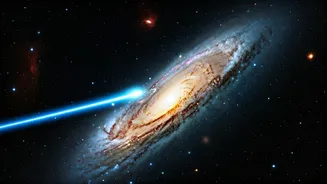
Until recently, the prime suspects for producing these high-energy neutrinos were blazars. A blazar is a type of active galactic nucleus (AGN) where a supermassive black hole at the center of a galaxy gobbles up surrounding matter and spews out a gigantic jet of particles and radiation pointed directly at Earth. In 2018, IceCube successfully traced a high-energy neutrino back to a specific blazar for the first time, a landmark moment for astronomy. Later, in 2022, another active galaxy, NGC 1068, was also identified as a source. While these discoveries were significant, the numbers didn't add up; the known blazars and AGNs could only account for a small fraction of the total neutrinos IceCube was detecting, leaving a significant portion of the 'ghost particle' background unexplained.
A New Galactic Contender
Recent findings published in mid-2026 have pointed astronomers in a surprising new direction. The trail began on September 22, 2021, when IceCube detected a particularly high-energy neutrino, dubbed IC 210922A. An alert sent astronomers scrambling to find its source. After initial searches for a blazar came up empty, a team turned their attention to a different type of object: a distant, incredibly bright, and dusty galaxy nicknamed 'Shadow Blaster'. They discovered that the galaxy's immense energy was not coming from a supermassive black hole, as expected, but from an extraordinarily intense period of star formation, a 'starburst'. This discovery provided the first strong evidence linking an individual high-energy neutrino to a star-forming galaxy.
Evidence from the Dust
The Shadow Blaster galaxy, located about 11 billion light-years away, is a hive of activity, forming stars at a furious pace. Such 'starburst' galaxies are filled with dense clouds of gas and dust, creating the perfect environment to accelerate particles to immense speeds. Theoretical models have long suggested that these dense, chaotic environments could be efficient neutrino factories. Cosmic rays, accelerated by events like supernova explosions, would get trapped within the dusty clouds, colliding with other particles and producing a shower of neutrinos in the process. Because the galaxy is so dusty, it's nearly invisible in normal light, which is why it was nicknamed Shadow Blaster. However, radio telescopes were able to peer through the dust and reveal its compact, energy-rich core, confirming it has the right conditions for neutrino production.
A New Window on the Universe
This finding does more than just solve the mystery of a single neutrino; it changes our understanding of the high-energy universe. The study's authors estimate that the population of compact, dusty star-forming galaxies like Shadow Blaster could be responsible for a significant chunk—perhaps up to 20%—of the total high-energy neutrino background detected by IceCube. This suggests that supermassive black holes are not the only major players. A substantial number of cosmic neutrinos may be forged in the stellar nurseries of intensely active galaxies. This opens up a new class of objects for astronomers to study and strengthens the field of 'multi-messenger astronomy,' where information from particles like neutrinos is combined with data from light and gravitational waves to get a more complete picture of cosmic events.