







A Mission That Keeps on Giving
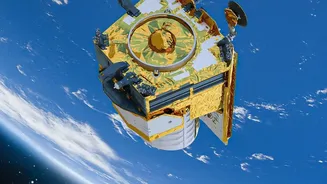
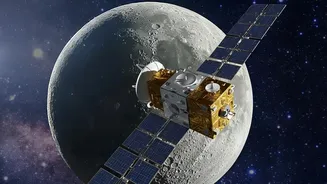
Launched in 2008, Chandrayaan-1 was India’s pioneering first mission to the Moon. While its operational life was cut short, the scientific data it gathered remains a goldmine for researchers. The mission carried a suite of instruments, including the Moon Mineralogy
Mapper (M3), a NASA-provided spectrometer. This instrument didn't just take pictures; it analyzed the composition of the lunar surface by reading how different minerals reflect light. It is this data, re-analyzed years later by scientists at the Physical Research Laboratory (PRL) in Ahmedabad, that has led to the new discovery, proving the mission's incredible long-term value.
What and Where Is the Australe Basin?
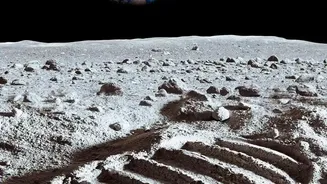
The Australe Basin is located in the Moon's southeastern hemisphere, a vast and rugged area partially on the far side of the Moon. For years, scientists have suspected a large impact basin was there, but the evidence was inconclusive. Unlike the Moon's other great basins, Australe lacks the obvious giant circular rim or clear topographic signature. Billions of years of subsequent smaller impacts, volcanic activity, and surface erosion have essentially worn it down, making it a 'ghost' crater, invisible to conventional cameras looking for a physical shape.
Reading the Mineral Fingerprints
So how do you find a crater that's been erased? You look for the evidence it left behind. The PRL scientists acted like geological detectives. When a massive asteroid strikes a planet or moon, the impact is powerful enough to excavate material from deep within the crust and mantle, blasting it outwards in a ring. By analyzing the M3 data, the researchers found a distinct, broad circle of a mineral called orthopyroxene around the Mare Australe (Southern Sea) region. This mineral is associated with deeper lunar material, acting as a chemical fingerprint proving a colossal impact occurred there long ago. This mineral ring effectively outlines the boundary of the long-lost basin.
Why This Finding Is a Big Deal
This discovery isn't just about finding another crater; it's about rewriting the Moon's earliest history. Some evidence suggests the Australe Basin may predate the South Pole-Aitken (SPA) basin, which is currently considered the oldest and largest known impact structure in the entire solar system. Confirming this would give us new insights into the violent, early days of our solar system, a period known as the Late Heavy Bombardment. Furthermore, the basalts (volcanic rocks) inside the basin have an unusual composition—low in calcium but high in magnesium—which is different from most lunar volcanoes. This uniqueness can tell us more about the Moon's deep interior and its evolution.
Without the Hype: Context for the Future
It is important to understand what this discovery does and does not mean. It is not about finding water or resources for immediate use, which is often the focus of current south pole exploration. Instead, this is fundamental science that helps us build a better map of the Moon's geological history. It informs our understanding of how ancient impacts distributed materials across the lunar surface. Interestingly, the magnesium-rich material identified here is similar to what the Chandrayaan-3 lander found at its Shiv Shakti Point landing site, suggesting a possible connection between the two locations despite the distance. This knowledge is crucial for planning future missions, like India's proposed Chandrayaan-4 sample-return mission, as it helps scientists understand the origin of the materials they might collect.