
The Universe's Giant Problem
Imagine looking back in time to the universe's infancy, just a few hundred million years after the Big Bang, and finding giants. Astronomers using the James Webb Space Telescope (JWST) have done just that, repeatedly finding supermassive black holes (SMBHs)
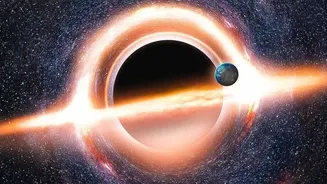
weighing millions or even billions of times more than our sun. The existence of these cosmic monsters so early on is a major paradox. According to our standard understanding, black holes need time to grow. They typically start from the collapsed cores of massive stars and gradually feed on gas, dust, and other stars. This process is slow. Finding such enormous black holes so soon after the universe began is like finding a fully-grown redwood tree just a few years after the seed was planted; it simply shouldn't have had enough time to get that big.
Heavy Seeds for Rapid Growth
To solve this puzzle, scientists have proposed different theories. One idea is that the first "seed" black holes formed from the remnants of the first stars, which were relatively small, perhaps 10 to 100 times the mass of the sun. But for these to grow into the giants we see, they would have needed to consume matter at an impossibly high rate. An alternative theory suggests the existence of "heavy seeds." These would be black holes that started much bigger, perhaps with masses of 10,000 to 100,000 times that of the sun. They could have formed from the direct collapse of huge, dense clouds of gas in the early universe. A bigger starting point would give them a crucial head start, making it more plausible for them to reach supermassive status so quickly. The problem? Until recently, there was no direct evidence for these heavy seeds.
Enter MoM-BH-1: A New Kind of Object
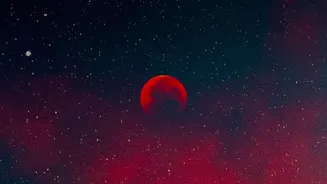
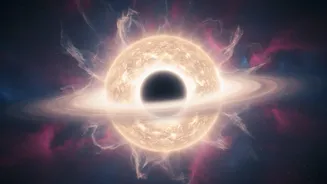
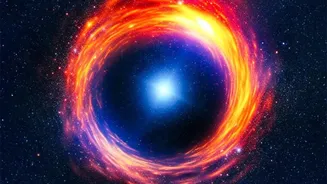
This is where the new discovery comes in. An object named MoM-BH-1, spotted by the JWST, appears to be something entirely new: a 'black hole star'. Found as part of the 'Mirage or Miracle' (MoM) survey, it's an intensely bright, red object seen as it was about 660 million years after the Big Bang. According to analysis by a team of researchers, MoM-BH-1 isn't a normal star or a typical black hole. Their models suggest it consists of a central black hole about 100,000 times the mass of our sun, surrounded by a massive, dense envelope of hydrogen gas that is roughly the size of our solar system. The black hole provides the immense energy, while the gas cloud glows like a star's surface, making it look like one enormous, bright red star.
The Missing Link and the 'Little Red Dots'
The mass of the black hole at the heart of MoM-BH-1 places it squarely in the 'heavy seed' category, making it the missing link scientists have been searching for. It's a snapshot of a direct-collapse black hole in its infancy, showing how these objects could form and provide the foundation for the later supermassive giants. This discovery might also solve another JWST-era mystery: the numerous 'little red dots' that appear in nearly every deep-space image. Researchers now suspect that many of these dots could be black hole stars just like MoM-BH-1, embedded within their host galaxies. MoM-BH*-1 is special because it is so bright that it completely outshines its galaxy, allowing astronomers to see the light from the black hole star itself. This provides a template to help understand the nature of all the other little red dots scattered across the dawn of time.