




Why Your First Dive Feels Like a Test
It's completely normal to feel like you're being graded on your first dive. You're in an alien environment, wearing unfamiliar gear that hisses and bubbles, and you have a list of skills you need to perform. Common anxieties include the fear of running
out of air, panicking, or messing up in front of the group. This pressure often comes from within—a desire to be a 'natural' or not hold others back. But dive instructors don't expect you to be an expert. They expect you to be a beginner. Acknowledging that this pressure exists is the first step to letting it go.
The Real Goal: Comfort, Not Perfection
The primary objective of a first-time experience, like a Discover Scuba Diving program, isn't to make you a flawless diver; it's to get you comfortable with the sensation of breathing underwater. The entire session is designed to be a slow, guided introduction. Success isn't about mastering every skill on the first try. It’s about ending the dive safely, feeling more relaxed than when you started, and being excited to explore more. Your instructor's job is to ensure your safety and build your confidence at a pace that works for you.
Focus on Slow, Deliberate Breathing
If there's one thing to focus on, it's your breathing. Nervous divers tend to take short, shallow breaths, which can increase anxiety and use up air more quickly. Instead, concentrate on taking slow, deep, and deliberate breaths. This technique has a powerful calming effect, slows your heart rate, and helps you achieve better buoyancy control. Feeling your belly expand with each inhale and listening to the rhythmic sound of the bubbles on your exhale gives you a simple, meditative task to focus on, pushing other anxieties to the background.
Embrace the Skill Practice
During your first session, you'll practice a few fundamental skills in shallow, calm water, such as clearing your mask if it fills with a little water, and recovering your regulator (the mouthpiece you breathe from). These are not pass/fail exercises. They are opportunities to learn that you can solve minor problems calmly. No one gets mask clearing perfect the first time, and that's okay. Your instructor is right there to guide you through it as many times as you need. Remembering that you can still breathe from your regulator even when your mask has water in it is a huge confidence booster.
Communicate Openly With Your Instructor
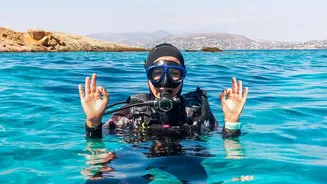
Your instructor is your most important asset underwater. They are trained to manage nervous divers and welcome your questions and concerns. If you're feeling anxious, tell them. If your ears are bothering you during descent, signal to them immediately. Diving uses a simple set of hand signals for communication, and being clear about what you're feeling is crucial for your safety and comfort. They can slow things down, offer one-on-one attention, and provide reassurance. You are never alone during this process.
Redefining a 'Successful' First Dive
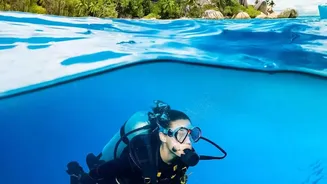
It's time to redefine what success looks like. A successful first dive isn't one where you use the least amount of air or look like a seasoned pro. A successful first dive is one where you get in the water, follow your guide's instructions, manage to find a sense of calm, and witness the magic of the underwater world for the first time. It’s about the experience of weightlessness and seeing marine life up close. The skills will come with more practice. For now, the only goal is to finish with a smile and a desire to do it all over again.