





An Explorer's Second Wind
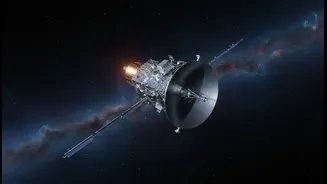
On July 7, 2026, NASA announced that New Horizons had successfully emerged from a 321-day hibernation, its longest sleep to date. The signal confirming its revival took nearly nine hours to cross the immense distance to Earth. Launched in 2006, the probe
became a household name in 2015 when it gave humanity its first close-up look at Pluto, revealing a world of towering ice mountains, vast nitrogen glaciers, and hints of a subsurface ocean. Four years later, it studied Arrokoth, the most distant object ever visited by a spacecraft. Many missions would end there, their primary objectives complete. But New Horizons was just getting started on its second act.
A New Mission in the Twilight Zone
Today, New Horizons has a different job. Instead of preparing for a specific flyby, it has become a unique observatory in the Kuiper Belt, the vast, icy debris field beyond Neptune. Its new primary purpose is to study the heliosphere — the giant bubble of charged particles blown outward by our sun. Mission scientists are using its instruments to measure how this solar wind behaves as it travels into the cold, dark expanse. Think of it as mapping the true edge of the solar system, where the sun's influence finally gives way to interstellar space. This is a region no other active mission is currently exploring, providing an invaluable scientific return on a long-term investment.
Whispers from the Void
Even during its long nap, New Horizons was working. Several instruments remained active, collecting data on the sparse dust and particle environment of the outer solar system. Now that it’s awake, it will begin beaming that information back to mission control at the Johns Hopkins Applied Physics Laboratory. Recent findings from the probe have already shown that the solar wind is slowing down significantly as it collides with interstellar particles, a key piece of the puzzle in understanding our solar system's boundary. In the coming weeks, its ultraviolet spectrograph will begin a new observation campaign, studying the distribution of hydrogen gas in this distant region. It’s also used its powerful camera to spot a potential population of objects that hint the Kuiper Belt may be even larger than we thought.
Keeping a Veteran Spacecraft Flying
Operating a 20-year-old spacecraft so far from home is a masterclass in ingenuity. The probe runs on a radioisotope thermoelectric generator, which produces power from the decay of plutonium. As that power dwindles, engineers must make every watt count. This is why they use long hibernation periods, shutting down non-essential systems for months or years at a time. Communication is another challenge; the immense distance means commands and data travel for hours. To cope, the team has uploaded software updates that give New Horizons more autonomy, allowing it to manage its systems and diagnose problems without constant input from Earth.
The Long Journey Ahead
What's next for the intrepid explorer? NASA has extended the mission until at least 2028, when it is expected to leave the Kuiper Belt behind. While no third flyby target has been identified, the mission team is actively searching for a reachable Kuiper Belt Object using powerful ground-based telescopes. The current operational plan preserves fuel, allowing for a potential rendezvous should a suitable candidate be found. After that, New Horizons will follow the Voyager probes into interstellar space. It will continue to collect data for as long as it has power, possibly into the 2050s, becoming a silent ambassador from humanity to the stars.