


A Long-Standing Cosmic Mystery
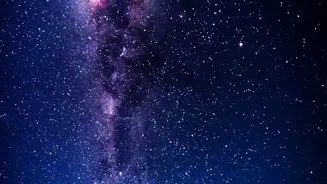
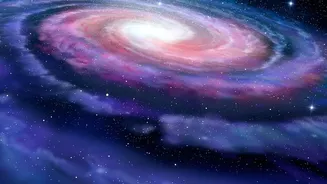
From our perspective on Earth, the Milky Way appears as a brilliant band of stars stretching across the night sky. For decades, astronomers have known that this band, the galactic disc, isn't perfectly flat. It’s warped at the edges, and the entire disc is tilted
at a strange angle relative to the vast, spherical halo of stars and invisible dark matter that surrounds it. This tilt was a puzzle, but it wasn't the only one. Another perplexing observation involved the stars in the galaxy's halo—a sparse, ancient cloud of stars enveloping the main disc. While stars in the disc, including our Sun, zip around the galactic center at about 220 kilometres per second, the halo stars move far more sluggishly, at only about 25 kilometres per second. For years, scientists couldn't definitively explain this dramatic speed difference or the galaxy's skewed orientation. They knew something big must have happened in our galaxy's past, but the culprit remained elusive.
The Prime Suspect: Gaia-Sausage-Enceladus
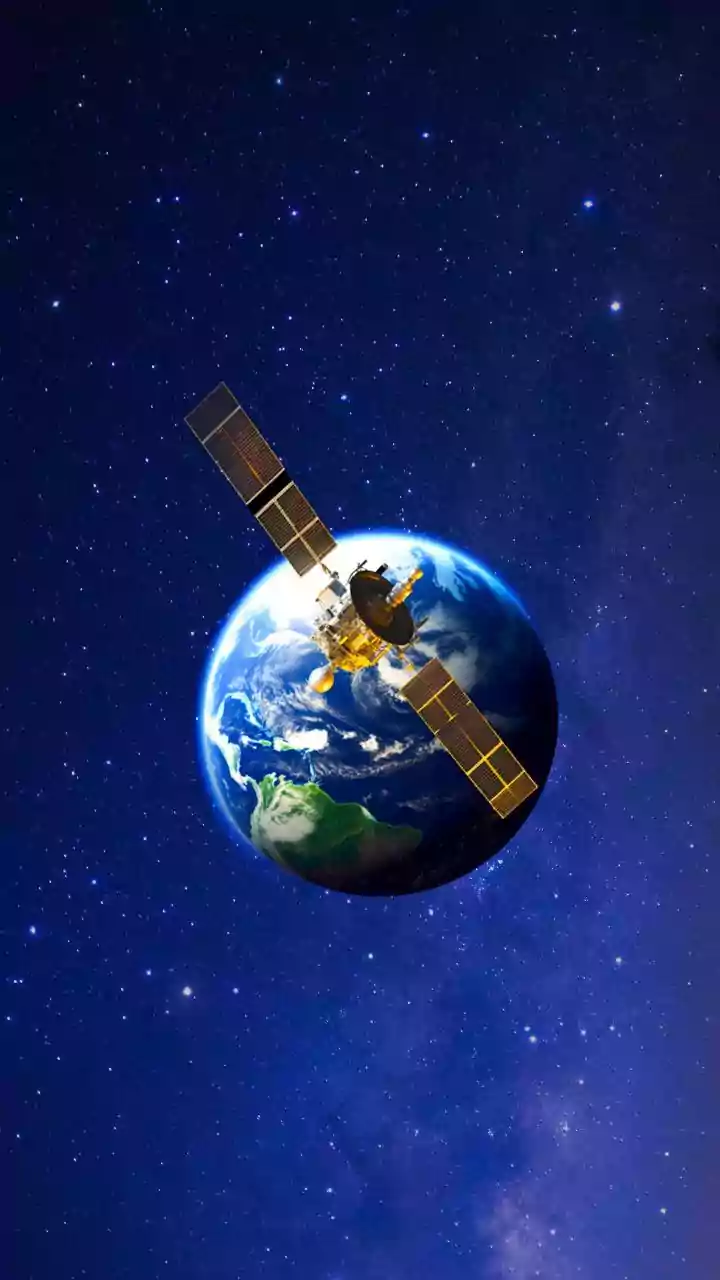
The key breakthrough came from connecting the tilt to an event first identified in 2018. Using data from the European Space Agency’s Gaia space telescope, which is meticulously mapping the positions and motions of billions of stars, astronomers uncovered the remnants of an ancient galactic merger. They found a distinct population of stars moving in unusual, elongated orbits, plunging in and out of the galactic center. When plotted, their paths looked like a sausage, leading to the memorable nickname Gaia-Sausage-Enceladus, or just Gaia Sausage for short. This wasn't just any small merger; it was the last major collision in the Milky Way's history, happening around 10 to 11 billion years ago, long before our Sun was born. Though classified as a dwarf galaxy, Gaia Sausage was massive, containing gas, dark matter, and stars equivalent to over 10 billion times the mass of our sun.
Unlocking the Truth with Supercomputers
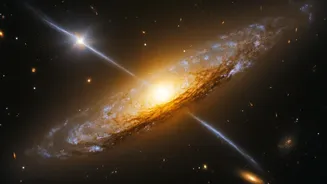
Armed with the knowledge of this ancient collision, researchers at Durham University turned to powerful supercomputer simulations to see what would happen if a Milky Way-like galaxy suffered a direct, head-on hit from a Gaia Sausage-sized object. The simulations were designed to solve the mystery of the slow-moving halo stars. The results were stunningly clear. The models showed that when a galaxy endured such a cataclysmic, head-on crash, the chaos and gravitational forces unleashed were enough to cause the entire galactic disc to gradually reorient itself. This process, called a "disc flip," wasn't instantaneous. Instead, over hundreds of millions of years, the spinning disc of stars and gas was torqued into a new position, tilting by more than 90 degrees from its original orientation.
A Galaxy Flipped on its Side
This cosmic somersault elegantly explains both of the long-standing mysteries. The collision fundamentally reshaped the young Milky Way, scattering the stars from the Gaia Sausage galaxy into the wide, slow-moving halo we observe today. The impact's immense energy effectively cancelled out much of the halo's original rotational momentum. At the same time, the gravitational torque from the massive collision slowly pulled the main disc into its current tilted alignment. So, our galaxy isn't just slightly warped; it was effectively knocked over. The findings, presented at the Royal Astronomical Society's National Astronomy Meeting in July 2026, suggest that if we could have watched this unfold, the entire night sky would have gradually changed as the galaxy reoriented itself.