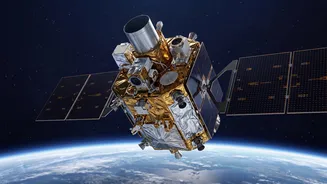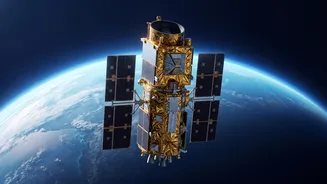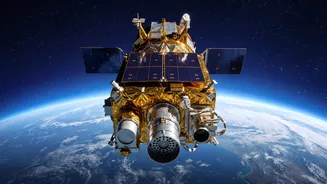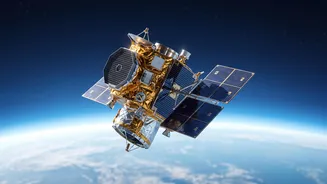







After nearly 22 years of scanning the cosmos for the universe's most violent explosions, one of NASA's most resilient telescopes has come home. The Neil Gehrels Swift Observatory ended its mission with a fiery plunge through Earth's atmosphere.
A Fiery Finale Over Indonesia
On Wednesday,
November 4, the story of the Swift Observatory came to a dramatic close. U.S. Space Force tracking data confirmed the 1,452-kilogram spacecraft re-entered the atmosphere at 12:39 UTC over the North Sumatra region of Indonesia. Travelling at incredible speeds, the observatory broke apart and largely burned up due to the intense heat from atmospheric friction. While NASA expected most of the satellite to be incinerated, the agency acknowledged that some dense components might have survived the fall. As of November 6, no injuries or damage on the ground have been reported. The re-entry marked the final chapter for a mission that far outlasted its original two-year design life.
What Was the Swift Observatory?
Launched on November 20, 2004, the Neil Gehrels Swift Observatory was a multi-wavelength space telescope dedicated to solving one of astronomy's biggest mysteries: gamma-ray bursts (GRBs). These are the most powerful explosions in the universe, believed to be caused by collapsing massive stars or merging neutron stars. Swift's key innovation was its speed. As its name suggests, the observatory could autonomously 'swiftly' pivot to a newly detected burst within about a minute. This allowed its three telescopes—working in gamma-ray, X-ray, ultraviolet, and optical light—to capture the fading afterglow of these fleeting events, giving scientists an unprecedented look at their origins and evolution.
An Unexpectedly Long and Fruitful Mission
Though initially planned for a two-year mission, Swift proved to be a durable and versatile workhorse for more than two decades. Beyond its primary goal, it became a crucial tool for 'target of opportunity' astronomy. Its rapid response capabilities were used to study a vast range of cosmic phenomena, including over 1,400 supernova explosions, stars being torn apart by black holes, and even comets and asteroids within our own solar system. The data collected by Swift has contributed to approximately 7,000 scientific papers, cementing its legacy as one of NASA's most productive astrophysics missions.
Why Did Swift Fall from Orbit?
Satellites in low Earth orbit are in a constant battle with atmospheric drag. Increased solar activity can cause Earth's upper atmosphere to expand, slowing down satellites and causing their orbits to decay. This is what happened to Swift, which had no onboard propulsion to counteract this effect. Its orbit began to drop noticeably, and by October 2026, it was too low to conduct stable science operations. A last ditch effort to save the observatory with a commercial rescue mission failed in August 2026, after the robotic tug sent to boost Swift's orbit experienced its own technical issues. With no other options, NASA officially ended the mission on October 23, preparing for its inevitable, uncontrolled re entry.
The Growing Concern of Space Debris
While the individual risk from a single re entry event like Swift's remains extremely low—NASA estimated the chance of harm at 1 in 2,100—the broader issue of space junk is a growing concern. Most of a satellite burns up, but between 10 to 40 percent of a large object's mass can survive, typically as dense, heat resistant components like fuel tanks or engine parts. With thousands of active satellites and tens of thousands of tracked debris objects in orbit, managing the end of life for this technology is a major challenge. Events like Swift's re entry highlight the need for sustainable practices in space, including designing satellites for controlled de orbits over unpopulated ocean areas to ensure safety on the ground.