



A Cosmic Powerhouse Mystery
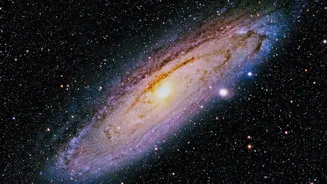
Deep within our galaxy, astronomers have detected sources of gamma rays with energies far exceeding anything achievable on Earth. These natural particle accelerators, sometimes called 'PeVatrons', can energize particles like protons to a peta-electron-volt
(PeV)—that's a quadrillion electron volts, or about 100 times more powerful than the Large Hadron Collider. For years, scientists have worked to pinpoint exactly what kind of cosmic engines are responsible for this immense power. Identifying them is a major goal in astrophysics, as it would help unravel how the most energetic particles in our galaxy are made and how they travel through space. The challenge is that these particles, being electrically charged, are deflected by magnetic fields, scrambling their paths and making it impossible to trace them directly back to their point of origin. Instead, scientists hunt for the gamma rays produced when these particles collide with interstellar gas near their source.
The Usual Suspects
Traditionally, the search for PeVatrons has focused on the most violent and energetic objects known in the cosmos. Prime candidates have included supernova remnants—the expanding shockwaves from exploded stars—which are known to accelerate particles to incredible speeds. Another leading suspect has been the supermassive black hole at the center of our galaxy, Sagittarius A*, which could have been more active in the past. Pulsars, which are rapidly spinning, highly magnetized remnants of dead stars, are also considered. These objects can create vast 'halos' of energetic particles around them, making them prime locations to search for high-energy gamma-ray signals. However, observations of these sources often don't perfectly match the models. In many cases, the gamma-ray glows detected by observatories like the High Energy Stereoscopic System (H.E.S.S.) in Namibia have no obvious counterparts at other wavelengths, like X-rays or radio waves, creating what are sometimes called 'dark' accelerators.
A New 'Kilonova' Hypothesis
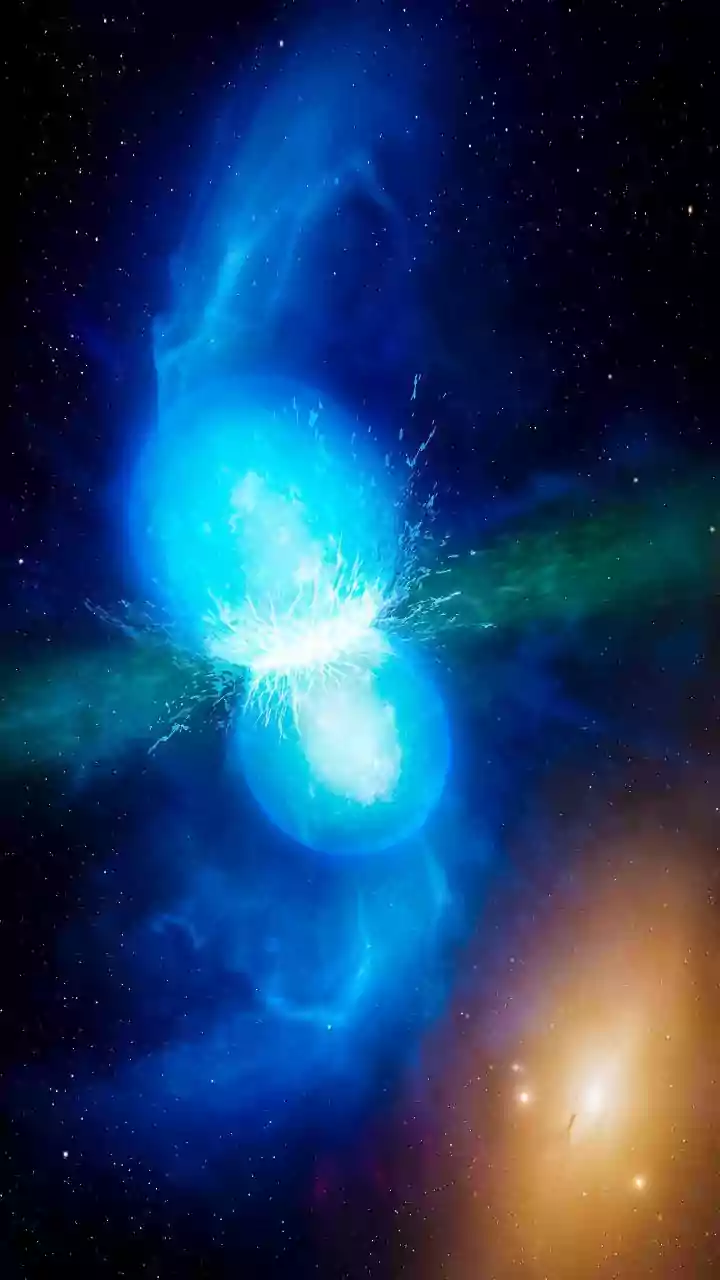
Recently, a team of researchers proposed a different and intriguing explanation for at least one of these mysterious sources. According to a new study focusing on an enigmatic source named HESS J1507−622, the gamma rays may not be from a supernova or pulsar, but from the aftermath of a 'kilonova'. A kilonova is a cataclysmic collision between two incredibly dense neutron stars. Such an event is powerful enough to forge the heaviest elements in the universe, like gold and platinum, and unleash a tremendous blast of energy and material into space. This new hypothesis is compelling because it can explain some of the unusual properties of HESS J1507−622, such as its location away from the main plane of the Milky Way, where most stars reside. A binary neutron star system could have been 'kicked' out of the galactic plane by the very explosions that created the stars themselves.
The Evidence and What It Means
In a paper posted to the preprint server arXiv, scientists outlined a mathematical model showing that the debris from a neutron star merger could indeed produce the specific type of gamma-ray emission observed. The 'tentative' part of the explanation is crucial; this is a hypothesis that needs further testing and peer review. However, if confirmed, it would be a significant discovery. It would not only solve the puzzle of this particular high-energy source but also mark the first time a kilonova remnant has been identified within our own Milky Way galaxy. The researchers suggest the collision may have happened less than 1,000 years ago, creating a glowing cloud that is still bright and relatively small—hallmarks of a young cosmic remnant. This new idea adds another fascinating possibility to the list of potential cosmic accelerators, moving beyond the usual suspects and opening a new avenue for research.