





A World Within a World
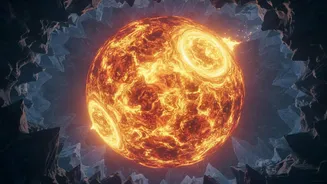
Deep inside our planet lies a world so extreme it defies imagination. The Earth’s core, located about 2,900 kilometres below the surface, is a two-part sphere of mostly iron and nickel. It consists of a solid inner core, about the size of the Moon, surrounded
by a liquid outer core. This outer core is a superheated ocean of molten metal, swirling and flowing in complex patterns. The movement of this electrically conducting fluid is not just a geological curiosity; it acts like a colossal dynamo, generating the planet's magnetic field. This field extends far into space, forming a protective bubble called the magnetosphere, which shields us from harmful solar radiation. Without this dynamic core, life on the surface would be impossible.
A River of Iron Reverses Course
For years, scientists believed the flow within the outer core was generally stable, with a dominant westward drift. But recent findings have turned that assumption on its head. A specific, massive stream of molten iron located deep beneath the Pacific Ocean has been observed doing something remarkable. Around the year 2010, this subterranean river, which had been flowing weakly to the west, suddenly reversed and began moving strongly to the east. This was not a subtle shift; it was a dramatic change in a system that was thought to evolve over much longer timescales. The discovery, pieced together from years of data, surprised the scientific community and opened up a new puzzle about the inner workings of our planet. The big question was not only what happened, but why.
How Scientists Read the Unseeable
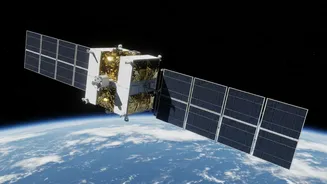
So, how do you "read" the movements of a molten ocean thousands of kilometres underground? You can't drill a hole or send a probe. Instead, scientists act like planetary detectives, using indirect clues. The primary tool is Earth's magnetic field itself. A fleet of sophisticated satellites, including the European Space Agency's Swarm mission, constantly monitors the magnetic field with incredible precision. As the liquid iron in the core moves, it pulls and stretches the magnetic field lines, causing tiny fluctuations that can be measured at the surface and from space. By analyzing these fluctuations over time, researchers can create models that reconstruct the flow of the molten core below. It’s like watching the ripples on a pond to understand the currents underneath. Scientists also use seismic waves from earthquakes, which travel through the planet and change speed based on the material they pass through, offering another way to map the core's structure.
What 'Sudden' Really Means
The word "sudden" can be misleading when talking about geology, where events are often measured in millions of years. In this context, the reversal beneath the Pacific is considered astonishingly rapid because it occurred on a human timescale—over just a few years. This decade-scale change challenges long-held theories that the core's large-scale flow was a slow, steady process. Interestingly, the latest data suggests this eastward surge may already be weakening, having peaked around 2020. This leads scientists to wonder if this event was a short-lived fluctuation, part of a repeating natural cycle that we've never seen before, or the beginning of a new, stable pattern. Continued monitoring is the only way to find out.
Why This Deep Reversal Matters
While these events are happening far beneath our feet and pose no immediate danger, they are fundamentally important to understanding our planet. The core's behaviour directly controls the magnetic field, our first line of defence against the harsh environment of space. Changes in the field can affect everything from satellite navigation and communication systems to the safety of astronauts. Furthermore, this core-flow reversal happened around the same time scientists detected a slowdown in the rotation of the solid inner core. This has led to speculation that the two events are connected, representing a complex interaction between different layers of the deep Earth. These deep movements can even have a minuscule effect on the length of a day, altering it by fractions of a millisecond.