





A Company Built by a Founder
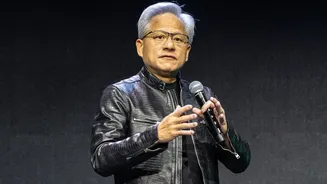
It’s nearly impossible to separate Nvidia from Jensen Huang. The co-founder, known for his signature leather jacket, transformed a company focused on graphics for video games into the engine of the artificial intelligence revolution. He didn't just lead;
he was the chief product visionary, top salesperson, and key relationship manager across the entire technology ecosystem. His departure, whatever the reason, leaves a vacuum at the center of one of the world's most important companies. At a recent all-hands meeting, the company's new interim leadership, led by former CFO Colette Kress, sought to reassure employees, stating that the corporate ambition and product plans remain unchanged. But the board's chair acknowledged the reality: you don't find a 'Jensen clone'. The challenge isn't just filling a role, but replacing a founder who was synonymous with the company itself.
The CUDA Moat: A Strategy Beyond Hardware
Nvidia’s first line of defense in a post-Huang era isn't a new chip; it's a software ecosystem called CUDA. Introduced in 2006, CUDA is the software platform that allows developers to access the parallel processing power of Nvidia's GPUs. For nearly two decades, almost the entire AI industry has been built on this platform. Major AI frameworks like TensorFlow and PyTorch are optimized for it, and millions of developers have invested their careers in learning it. This creates a powerful 'moat'—a significant barrier to switching. Migrating complex AI systems to a competitor's platform, such as AMD's ROCm, is costly and time-consuming. Even as competitors close the gap on raw hardware performance, Nvidia's advantage remains embedded in the software, libraries, and developer muscle memory that holds the AI world together.
A Roadmap Locked In for Years
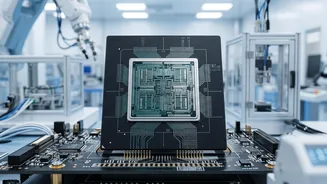
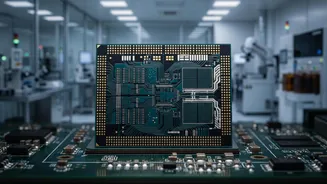
While a visionary CEO is crucial for setting long-term direction, the next few years of Nvidia's product pipeline are already in motion. The company has publicly shifted to an annual release cadence for its AI architectures. Following the currently ramping Blackwell platform, the Vera Rubin architecture is in production for 2026-2027, with its successor, codenamed Feynman, slated for 2028. This roadmap was confirmed by executives at the recent staff meeting. This means that for the next two to three years, the company's core products are locked in, a point analysts have noted provides short-term stability. Furthermore, Nvidia's expansion is not just about chips but the entire supply chain. Recent announcements detail massive investments and partnerships with manufacturers like TSMC, Samsung, and Amkor to expand capacity for everything from wafer fabrication to advanced packaging, securing the hardware pipeline well into the future.
The Challenge of the Competition
No company maintains an 80-85% market share forever without a fight. Huang’s departure will be seen as a moment of opportunity for Nvidia’s rivals. AMD is becoming a credible second source, with its MI300 series chips gaining traction. Meanwhile, Nvidia’s biggest customers—the hyperscale cloud providers like Google, Amazon, and Microsoft—are all developing their own custom AI chips (TPUs, Trainium, Maia) to reduce costs and their dependence on a single supplier. While these custom chips are mostly for internal workloads, they represent a strategic shift. The competitive landscape is no longer just about selling the fastest chip; it’s about the total cost of running AI models, including energy, networking, and software. A new leader at Nvidia will have to navigate a market that is far more complex and contested than the one of just a few years ago.
Who's on the Leadership Bench?
With Kress as interim CEO, the board's search for a permanent successor is underway, considering both internal and external candidates. Internally, Ian Buck is a name frequently mentioned. A two-decade Nvidia veteran, Buck is the creator of CUDA and leads the crucial data center business, giving him deep technical credibility. Externally, speculation has centered on figures like Arm CEO Rene Haas, who previously worked at Nvidia, and even AMD CEO Lisa Su, though recruiting a rival's successful leader would be a monumental task. The board has a difficult decision: choose a technologist who can continue Huang's product vision or a seasoned operator to manage the increasingly complex global business. The choice will signal the future direction for a company at a critical crossroads.