








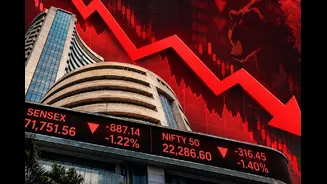
Indian investors are playing it safe. October's mutual fund data shows that while overall equity inflows cooled slightly, there was a noticeable rush towards the perceived safety of large-cap funds. What's behind this 'flight to quality'?
October's Tale of Two Trends
On the surface,
October 2026 was another strong month for Indian equity mutual funds, marking the 68th consecutive month of net positive inflows. However, the headline figure of ₹32,994 crore in net equity inflows, while robust, was about 14% lower than in September. But the real story lies beneath the surface. While money continued to pour in, investors changed their preferred destination. There was a clear and significant rotation of capital. Inflows into the popular small-cap and mid-cap categories saw a marked decline, falling by 29% and 38% respectively. In contrast, the large-cap category saw its inflows jump by over 20% to ₹1,032 crore. The standout performer, however, was the large-and-mid-cap category, which saw its inflows nearly double from the previous month to a staggering ₹8,484 crore, making it the top recipient of equity investments in October.
Why the Sudden Love for Large-Caps?
This shift isn't happening in a vacuum. It's a classic investor response to market uncertainty and a search for stability. Large-cap funds, which invest in India's biggest and most established companies, are often seen as a safe haven during volatile times. These are household names with strong track records, diversified businesses, and the financial muscle to weather economic headwinds. After a period where mid-cap and small-cap stocks delivered spectacular returns, leading to concerns about stretched valuations, investors appear to be taking a more cautious stance. Valuations in the large-cap space looked relatively more attractive in comparison. As of October, the Nifty 50 was trading below its long-term average price-to-earnings ratio, while the Nifty Midcap 100 was trading above its average, suggesting large-caps offered better value. This move signifies a 'flight to quality', with investors prioritising the stability of blue-chip stocks over the high-growth but higher-risk potential of smaller companies.
The Giants of the Industry
When investors look for large-cap exposure, they naturally gravitate towards the biggest players in the mutual fund industry. Asset Management Companies (AMCs) like SBI Mutual Fund, ICICI Prudential, and HDFC Mutual Fund are the behemoths of the Indian market, managing several lakh crore rupees in assets. SBI Mutual Fund, for instance, remains the country's largest fund house, managing over ₹13 lakh crore in average assets as of the September 2026 quarter. These large AMCs offer a wide array of schemes, including the large-cap, flexi-cap, and balanced advantage funds that are proving popular. While specific funds like Parag Parikh Flexi Cap have become some of the largest individual schemes by AUM, the overall trend benefits the large fund houses that have the brand recognition and distribution networks to capture these shifting investor preferences.
What Does This Mean for Your SIPs?
For the millions of Systematic Investment Plan (SIP) investors in India, this trend is worth noting but not necessarily a signal for panic or drastic change. Overall SIP contributions remained healthy in October at over ₹32,000 crore, showing that the core habit of systematic investing is intact. However, the shift in fund flows is a powerful reminder of market cycles. The outperformance of small and mid-caps doesn't last forever, and periods of consolidation are normal. For investors, this is a good moment to review their portfolio's asset allocation. Are you over-exposed to the riskier end of the market? Does your portfolio align with your risk tolerance and long-term goals? The current 'flight to quality' suggests a broader market sentiment that is prioritising capital preservation. It reinforces the wisdom of maintaining a balanced portfolio that includes a solid allocation to large-cap funds for stability, rather than chasing short-term trends.