



The Logic of the Lean
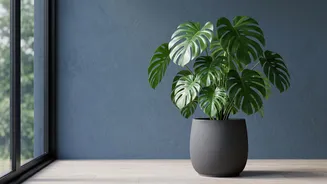
First, let's acknowledge why people rotate their plants. The tendency of a plant to grow towards a light source is a natural process called phototropism. Hormones called auxins accumulate on the shaded side of the stem, causing those cells to elongate
faster and making the plant bend towards the light. Rotating the pot forces the plant to correct its lean, encouraging more even, symmetrical growth. For a plant that's already getting enough light, this is a great habit for maintaining an aesthetically pleasing shape. It prevents one side from becoming full and lush while the back, facing away from the window, becomes sparse. The mistake is believing this rotation is a solution for a plant that is fundamentally light-deprived.
Sunlight as Food, Not Just Direction
The core issue is that light isn't just a directional cue for plants; it's their food. Through photosynthesis, plants convert light energy into chemical energy, creating the sugars they need to survive and grow. This process requires a certain quantity and intensity of light, not just a hint of it from one direction. While our eyes are great at adjusting to dim conditions, a room that feels bright to us can be deep shade for a plant. A spot on an interior wall might receive only 50-100 foot-candles of light intensity, whereas a spot near a bright window could get 500-1,000, and direct sun outside is closer to 10,000. Most common houseplants need between eight and 16 hours of adequate light per day to truly thrive.
Sharing Scarcity Doesn't Create Abundance
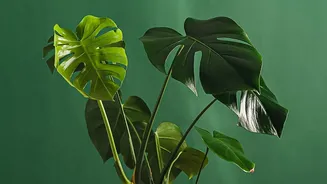
When a plant is in a location with insufficient light, rotating it doesn't create more energy. It simply redistributes the scarcity. A plant that is stretching and leaning isn't just trying to be symmetrical; it's desperately searching for enough energy to photosynthesize properly. Turning it around just forces another part of the plant to begin the same desperate search. Instead of having one side that's struggling, you end up with a plant that is uniformly weak, with twisted stems and leaves facing odd directions as they constantly try to reorient themselves. You are not solving the energy deficit; you are just ensuring all sides of the plant experience it equally.
Signs of a Light-Starved Plant
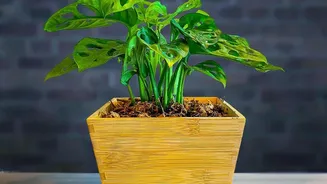
A plant that is leaning is often giving just one of many signals that it's not getting enough light. If you see these other symptoms, rotation is definitely not the answer. One of the most common signs is 'legginess', where the plant develops long, weak stems with large gaps between the leaves. Other indicators include new leaves that are smaller than older ones, a loss of variegation (colorful patterns reverting to plain green), yellowing lower leaves that drop off, and a general lack of new growth. A plant in this state is more susceptible to pests and other problems.
Real Solutions for Low-Light Spots
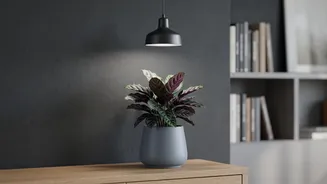
If rotating isn't the cure, what is? The answer is to address the root problem: the lack of light. Your first and best option is to move the plant to a brighter location. An east-facing window with gentle morning sun or a spot near a south-facing window is often ideal for many plants. If a better spot isn't available, your next option is to choose a plant that is genuinely tolerant of low light. Varieties like the Snake Plant (Sansevieria), ZZ Plant (Zamioculcas zamiifolia), Cast Iron Plant, and many Pothos and Philodendrons are adapted to survive in shadier conditions. Keep in mind that 'low-light tolerant' does not mean 'no-light'. A final, highly effective solution is to supplement with a full-spectrum grow light. Modern LED grow bulbs can fit into standard lamps and provide the specific wavelengths of light plants need for photosynthesis, allowing you to keep greenery almost anywhere.