


A New Look at Our Star
The image is mesmerizing. What looks like a field of golden, boiling kernels is actually a close-up of the sun's surface, a chaotic sea of roiling plasma. These cell-like structures, known as granules, are each about the size of Texas. They are the tops
of convection currents where hot gas from the sun's interior rises, spreads, cools, and sinks back down in the dark lanes between them. Recently released images from the National Science Foundation's (NSF) Daniel K. Inouye Solar Telescope in Hawaii have provided this unprecedented view. The level of detail is so fine that features as small as 12 to 18 miles across can be seen for the first time, offering scientists a chance to study the sun’s surface with staggering clarity.
The Eye on the Sun
Capturing such an image is a monumental technological feat. While the headline may point to NASA, the achievement belongs to the NSF's Inouye Solar Telescope, the largest and most powerful solar observatory in the world. Perched 10,000 feet up on Haleakalā in Maui, the telescope's location provides the clear, stable skies needed for such observations. Its primary mirror is a massive four meters (13 feet) across, allowing it to collect more sunlight than any other solar telescope. The real magic, however, lies in its adaptive optics system. This technology uses a network of sensors and deformable mirrors to correct for the blurring caused by Earth's atmosphere in real-time, effectively sharpening the image and enabling the incredible resolution we now see.
Why Visible Light Matters
Scientists observe the sun across the entire light spectrum, from X-rays to radio waves. Each wavelength reveals different features and layers of the star. Visible-light imaging, like that done by the Inouye telescope, is special because it shows us the photosphere—the sun's visible surface where most of its light is emitted. This is the source of space weather, the stream of charged particles and energy that flows from the sun and can impact Earth. While other telescopes might study the superheated outer atmosphere (the corona), visible-light observations allow us to see the very engine of that activity in its raw form. The new images have already confirmed the existence of a long-theorized process called the Kelvin-Helmholtz instability, where swirling vortices are created at the boundaries of moving plasma, which could play a key role in heating the sun's atmosphere.
The Science of Solar Weather
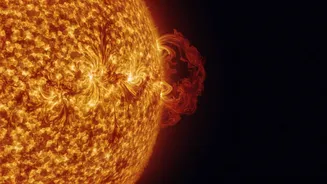
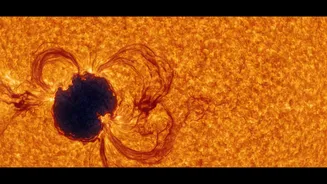
Understanding the sun isn't just an academic exercise; it has profound practical implications for our technology-dependent world. The sun’s magnetic fields are the source of solar flares and coronal mass ejections (CMEs)—massive eruptions that hurl billions of tons of plasma into space. If directed at Earth, this 'space weather' can wreak havoc, disrupting satellite communications, damaging power grids, and posing a risk to astronauts. By studying the fine details of the photosphere, scientists can better understand the fundamental physics that drives these explosive events. The ability to see magnetic fields twisting and turning at their smallest scales gives researchers the data they need to improve their models and, ultimately, their ability to forecast dangerous space weather.
Unlocking Solar Mysteries
These new, sharper images are more than just pretty pictures; they are treasure troves of data that could help solve some of the biggest mysteries in solar physics. One of the most enduring puzzles is the coronal heating problem: why is the sun's outer atmosphere, the corona, hundreds of times hotter than its surface? The newly observed instabilities and fine magnetic structures may hold the key, revealing how energy is transported and dissipated from the surface to heat the corona. By observing these processes up close, scientists hope to build a more complete picture of how our star works, from its deep interior to its far-reaching influence across the solar system.