




The Challenge of Finding Your Way
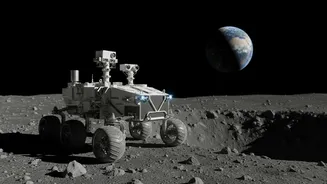
Imagine trying to get directions in a place with no street signs, no landmarks, and no GPS signal. That's the reality for explorers on the Moon. Currently, navigation relies on painstaking communication with teams on Earth and tracking from our planet.
This process is slow and has significant limitations, especially in areas like the lunar South Pole, where the Earth is barely visible above the horizon and extreme shadows obscure the terrain. For the ambitious goals of NASA's Artemis program, which aims to establish a long-term human presence on the Moon, this simply won't do. To build bases, conduct complex science, and ensure astronaut safety, a new solution is needed.
An 'Internet' for the Moon
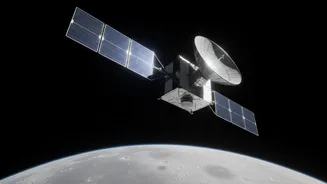
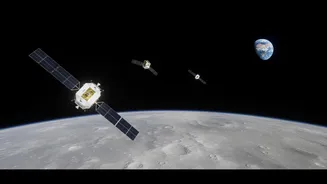
Enter LunaNet, NASA’s ambitious framework for a lunar communications and navigation network. Think of it less as a single system and more as creating an 'internet' for the Moon, complete with its own version of GPS. This network will be a collaboration between NASA and its commercial and international partners. The goal is to build a scalable, interoperable system where various satellites and ground assets can talk to each other seamlessly. This architecture is designed to grow over time, starting with initial robotic missions and expanding to support a bustling lunar ecosystem of astronauts, rovers, and permanent habitats.
How a Lunar GPS Works
The core of LunaNet's navigation service will function much like the GPS we use on Earth. A constellation of satellites in lunar orbit will provide positioning, navigation, and timing (PNT) signals to users on the surface or in orbit around the Moon. This will give astronauts and robotic rovers the ability to determine their precise location in real-time, independently of Earth. Interestingly, the system will be a hybrid. It will leverage weak but usable signals from Earth's existing GPS and Galileo satellites, but enhance them significantly with dedicated lunar relay satellites. NASA has already developed compact, powerful receivers, like the NavCube3-mini, designed specifically to pick up these signals at lunar distances, providing a crucial link in the chain.
More Than Just Navigation
LunaNet is designed to be far more than a simple positioning system. It's a multi-purpose infrastructure that will provide three core services: PNT, networking, and science. The networking component will enable reliable, high-bandwidth communications between astronauts, rovers, landers, and Earth, eliminating the frustrating communication blackouts that occur when the Moon blocks the line of sight to our planet. It will also provide critical safety alerts, such as warnings for hazardous space weather events, sent directly to astronauts much like a weather alert on a smartphone. This creates a robust digital backbone that is essential for routine operations and emergency response, including a search and rescue system called LunaSAR.
Building the Lunar Economy
By providing this foundational infrastructure, NASA is doing more than just enabling its own missions; it's paving the way for a vibrant commercial economy on the Moon. Through initiatives like the Commercial Lunar Payload Services (CLPS), NASA is partnering with private companies, such as Intuitive Machines, to deliver payloads and build out this network. These companies are contracted to not only carry NASA's science instruments but also to develop and operate the relay satellites that will form LunaNet. This approach stimulates the aerospace industry, reduces costs, and accelerates the development of a sustainable human and robotic presence where science, resource utilization, and commercial activities can flourish.