



A Treasure Trove of Data
The 2015 flyby was a fleeting encounter, lasting only hours. Yet, the spacecraft gathered so much information that it took 16 months just to transmit it all back to Earth. Scientists knew then that they had a treasure trove that would fuel discovery for decades.
Before New Horizons, our best images of Pluto were blurry pixels from the Hubble Space Telescope. Afterwards, we had high-resolution maps of a world far more complex and active than anyone had predicted, with towering ice mountains and vast glaciers. The initial findings were shocking, revealing a world that wasn't geologically dead. But the deeper, more complex stories are emerging now, as researchers apply new models and techniques to that priceless data.
The Heart of the Matter
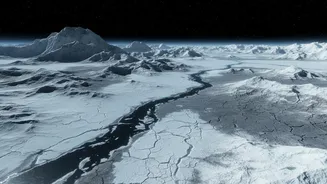
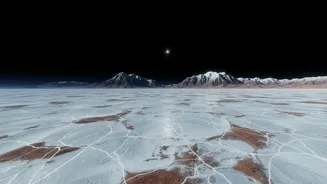
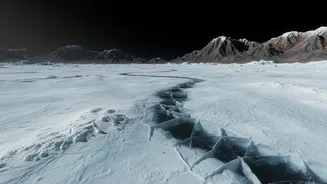
At the center of Pluto's story is Sputnik Planitia, the massive, heart-shaped glacier of frozen nitrogen larger than Texas and Oklahoma combined. This region immediately stood out for its lack of craters, suggesting a very young surface, perhaps less than a million years old, that was constantly being renewed. The surface is carved into city-sized polygonal cells, evidence of slow convection as the nitrogen ice churns over geological timescales. But recent analysis focused on dark streaks and diffuse features found along the northern edge of this stunning glacier. For years, scientists debated what these features were. Now, they believe they have an answer.
Evidence of Flowing Liquid
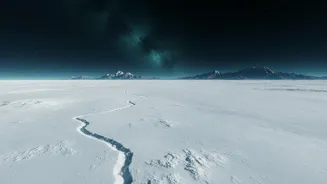
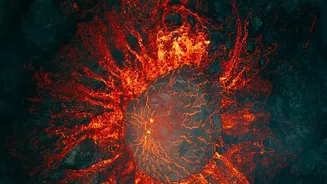
A new study published in the Planetary Science Journal presents the first evidence of recently flowing liquid on Pluto. By comparing the dark patterns on Sputnik Planitia to imagery of Earth's own ice sheets, scientists noted a striking resemblance to areas wetted by liquid. On Pluto, nitrogen rain is physically impossible due to the thin atmosphere and extreme cold. This led researchers to a different conclusion: the liquid nitrogen is welling up from beneath the glacier. Computer models showed that the immense pressure at the base of the kilometers-deep ice sheet could be enough to melt the nitrogen, a process called basal melting. This liquid nitrogen could then be forced up through cracks and fissures in the ice, briefly flowing across the surface before re-freezing.
A New Kind of Active World
This discovery fundamentally changes our understanding of Pluto. Finding evidence of liquid, even sporadically, on a world nearly six billion kilometers from the sun is a revelation. It suggests that Pluto may retain more internal heat than previously thought, allowing for ongoing geological processes. “Pluto never stops surprising us,” said Alan Stern, the principal investigator for the New Horizons mission. This finding points to a new type of time-variable feature on the dwarf planet, meaning its surface may be subtly changing even now. The idea that Pluto is not a static, frozen relic but a dynamic world has been one of the biggest takeaways from the 2015 mission, and this new evidence of subsurface liquid activity powerfully reinforces that conclusion.
Lessons for Future Exploration
Understanding the processes on Pluto has implications that reach far beyond one dwarf planet. It provides a crucial data point for how icy worlds behave at the edge of a solar system. The techniques used to re-analyze the New Horizons data—combining it with advanced computer simulations and comparisons to Earth-based geology—show how much value can be extracted from archived mission data. The lessons learned from Sputnik Planitia could help scientists interpret data from other distant, icy bodies like Neptune's moon Triton or other objects in the Kuiper Belt. It proves that even a brief glimpse of a distant world can provide enough scientific questions and answers to last for decades, reshaping our models of planetary science.