


India's Watchful Eye on the Sun
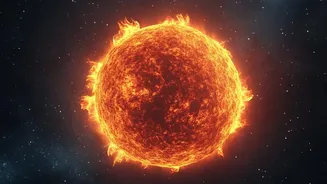
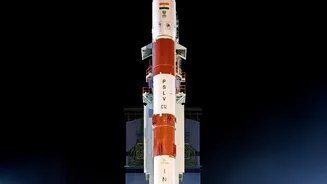
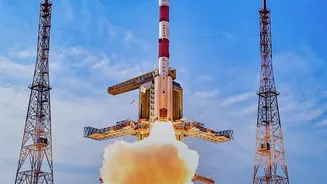
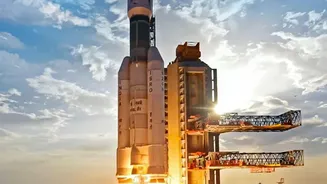
Positioned 1.5 million kilometres from Earth, ISRO's Aditya-L1 is India's first dedicated space-based mission to study the Sun. Launched in September 2023, it maintains a constant watch from a unique spot called Lagrange Point 1 (L1), giving it an uninterrupted
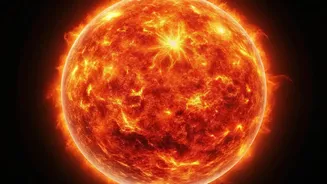
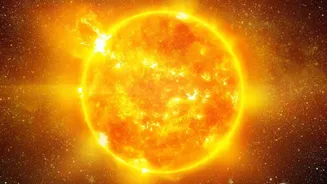
view of solar activity. Its primary goal is to help us understand solar phenomena like coronal mass ejections (CMEs)—massive bursts of plasma and magnetic fields from the Sun's atmosphere—and their impact on 'space weather'. This is crucial, as intense solar events can disrupt satellites, communication networks, and power grids on Earth.
Capturing a Lopsided Solar Storm
Scientists have long studied CMEs, often modelling them as symmetrical bubbles expanding uniformly outwards. However, a new study of an eruption that occurred on August 5, 2024, tells a different story. Researchers from the Indian Institute of Astrophysics (IIA) used Aditya-L1's main instrument, the Visible Emission Line Coronagraph (VELC), to analyse the event. They discovered that this particular CME did not expand evenly. Instead, it grew asymmetrically, developing an irregular, tilted shape as it burst from the Sun.
How VELC Uncovered the Asymmetry
This discovery was made possible by VELC's unique capabilities. While traditional instruments capture two-dimensional images of CMEs moving across the sky, VELC performs spectroscopy. It measures shifts in the wavelength of light, a phenomenon known as the Doppler effect. By detecting light that was both 'blue-shifted' (moving towards the observer) and 'red-shifted' (moving away), VELC revealed the eruption's hidden three-dimensional motion. The data showed plasma moving in different directions simultaneously, a clear signature of a complex, non-uniform expansion that a simple bubble model could not explain.
Improving Our Predictions for Space Weather
Why does the shape of a CME matter so much? An irregularly shaped eruption interacts with the surrounding solar wind differently than a uniform one. This can affect its speed, trajectory, and how much 'drag' it experiences on its journey through space. An asymmetric shape can ultimately alter if, when, and how intensely a CME strikes Earth. By revealing that the simple bubble model is not always accurate, Aditya-L1's finding provides a crucial piece of the puzzle. This knowledge will help scientists build more sophisticated and accurate models for forecasting space weather, offering better protection for our vital technological infrastructure.
A Collaborative Scientific Achievement
The research, published in The Astrophysical Journal Letters, was a collaborative effort. The IIA team combined the spectroscopic data from Aditya-L1's VELC with images from NASA's Solar Dynamics Observatory (SDO). They then used advanced 3D modelling to reconstruct the eruption's geometry. The model confirmed that a tilted and unevenly expanding CME was the only way to explain the observations from both spacecraft. This result not only showcases the advanced capabilities of ISRO's mission but also highlights the power of combining data from multiple international observatories to unlock the Sun's secrets.