




An Aggressive Push into Global Markets
Mahindra is no longer just a dominant force in the Indian market; it's making significant strides globally. The company has seen remarkable growth in its export numbers, with figures from May and June 2026 showing year-on-year increases of 37% and over
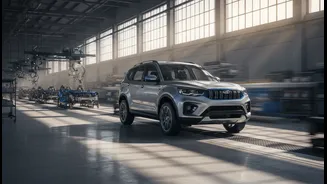
120%, respectively. This isn't accidental but the result of a focused strategy to penetrate key right-hand-drive markets. A landmark deal in early 2026 to supply 35,000 Scorpio Pik Up units to an Indonesian state-owned enterprise highlights this ambition. This single contract surpasses the company's entire export volume from the previous fiscal year, demonstrating a significant scaling of its international operations. The goal is clear: to establish a strong market share, with targets of 10-20% in certain overseas regions, by leveraging a robust and increasingly diverse product portfolio.
Pivoting to Cleaner, Electric-First Production
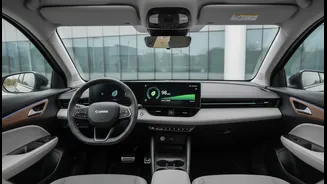
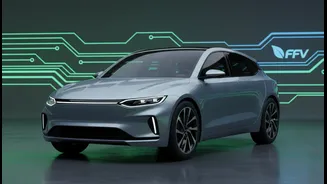
Parallel to its export drive, Mahindra is future-proofing its production lines with a heavy emphasis on sustainability and electric vehicles (EVs). The company has committed to achieving carbon neutrality by 2040 and is embedding its 'Planet Positive' framework across all operations. This includes making its facilities water-positive and certified as 'Zero Waste to Landfill'. A cornerstone of this green transition is the INGLO platform, a dedicated 'born-electric' architecture designed from the ground up for its next generation of EVs. This platform will underpin a range of new electric SUVs under the XUV and BE brands, moving Mahindra away from converting gasoline-powered cars to creating high-performance, software-driven vehicles that can compete globally. Production is already ramping up, with the company’s EV plant at Chakan now powered entirely by renewable energy.
The Rise of the Smart Factory
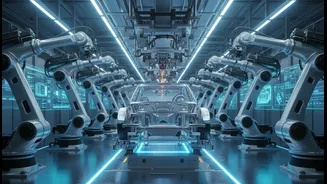
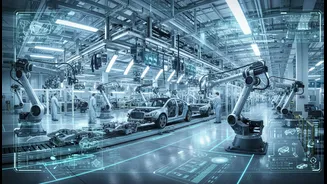
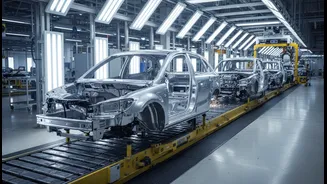
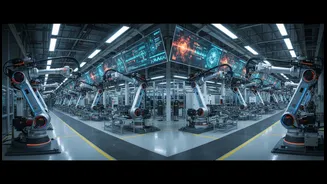
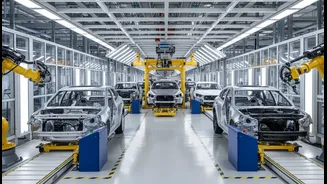
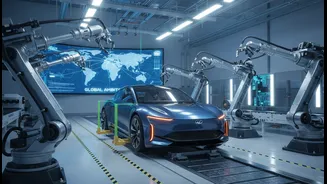
The 'how' behind this dual push is a deep investment in advanced manufacturing technology. Mahindra's facilities, particularly the Chakan plant, are rapidly evolving into 'smart factories'. The company is deploying Industry 4.0 technologies, including extensive use of robotics, Artificial Intelligence (AI), and the Internet of Things (IoT). Its EV manufacturing hub in Chakan features a highly automated ecosystem with over 1,000 robots to enhance efficiency and quality. AI-driven monitoring systems track processes like spot welding to reduce defects, while generative AI chatbots assist with maintenance troubleshooting. This embrace of automation is crucial for producing vehicles that meet stringent international quality standards, a prerequisite for succeeding in competitive export markets. The recent rollout of the three-millionth vehicle from the Chakan plant, a BE 6 electric SUV, symbolizes this successful integration of scale and technology.
Investing in an Integrated Future
Mahindra's strategy is not about choosing between exports and domestic investment, but about making them work in tandem. The high-quality, efficient production enabled by automation and green technology is precisely what allows its vehicles to be competitive abroad. Looking ahead, the company is doubling down on this integrated approach. It has announced a massive ₹15,000 crore investment to build its largest-ever integrated manufacturing facility in Nagpur, which will produce both conventional and electric vehicles for domestic and global markets. This new plant, expected to start production in 2028, will have an annual capacity of over 500,000 vehicles and will be supported by a dedicated supplier park to strengthen the entire value chain. By building world-class products in India for both local and international customers, Mahindra is positioning itself not just as an automaker, but as a global manufacturing powerhouse.