
A Cosmic Crash Like No Other
Cast your mind back to 2017. For the first time in history, scientists detected both gravitational waves and light from the same cosmic event: the cataclysmic merger of two neutron stars. Dubbed GW170817, the event was a goldmine of data. It occurred
130 million light-years away, and the collision sent ripples through spacetime that were picked up by detectors on Earth. Telescopes across the globe quickly pivoted to the source, witnessing the kilonova—a massive explosion that forged heavy elements like gold and platinum and blasted them into space. It was a monumental achievement for multi-messenger astronomy, the practice of using different kinds of signals to observe the universe. But amidst the celebration, a central question lingered: what object was born from the ashes of this cosmic dance?
The Search for a Survivor
The fate of the object at the heart of GW170817 has been one of modern astronomy’s most compelling mysteries. When two neutron stars, the incredibly dense collapsed cores of giant stars, merge, the outcome depends on their combined mass. If the mass is great enough, the remnant should have immediately collapsed into a black hole, an object so dense that not even light can escape its gravitational pull. If the combined mass was just below that critical threshold, it might have formed a hypermassive neutron star that survived for a few milliseconds before collapsing. But there was a third, more tantalizing possibility: the merger could have formed a stable, massive neutron star, an object that would continue to exist, spinning and emitting energy into the cosmos. Finding such a survivor would provide an invaluable natural laboratory for studying matter under the most extreme conditions imaginable.
A Magnetar Enters the Scene
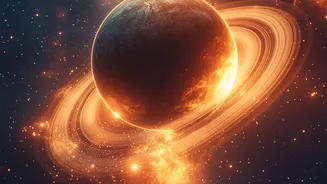
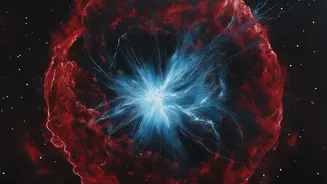
A new paper, which has been made public on a preprint server but has not yet undergone formal peer review, claims to have finally identified this very survivor. The research team argues that long-term observations from NASA’s Chandra X-ray Observatory reveal an X-ray signature consistent with a magnetar—a special, highly unusual type of neutron star. A magnetar is a neutron star with an ultra-powerful magnetic field, trillions of times stronger than Earth’s. This intense magnetic field would act like a cosmic dynamo, spinning rapidly and injecting energy into the surrounding debris cloud. According to the researchers, the X-ray glow from the GW170817 site has remained too bright for too long to be explained by other phenomena. They propose that this steady energy source is the 'smoking gun' signature of a newly-born magnetar, which has been powering the afterglow for years.
Why This Finding Matters
If confirmed, this discovery would be a landmark moment. It would not only solve the mystery of GW170817’s remnant but also have profound implications for our understanding of physics. The mere existence of such a massive, stable magnetar would challenge and refine our models of nuclear matter and the absolute limits of density before collapse into a black hole. Furthermore, it would help explain how the universe creates its heaviest elements. The energy pumped out by a magnetar could significantly influence the kilonova ejecta, affecting the amount and distribution of precious metals forged in the merger. It would provide a direct link between the gravitational wave event and the creation of the elements we find on Earth.
The Crucial Caveat: Awaiting Peer Review
It is essential, however, to approach this exciting claim with a healthy dose of scientific skepticism. The research has been posted to a repository where scientists can share early results, but it has not yet passed through peer review. This is the formal, rigorous process where independent experts in the same field scrutinize a study’s methods, data, and conclusions. They check the math, question the assumptions, and decide if the evidence truly supports the claims. It is the bedrock of scientific validation. Other astronomers will now pore over this data, perhaps proposing alternative explanations for the X-ray signature. This process is not a criticism but a crucial part of how science self-corrects and builds a reliable understanding of the world. The claim is on the table, but the jury is still out.