

Your Simple Stargazing Starter Kit
Getting into skywatching is easier than you might think. The most important first step is to get away from city lights, which can wash out all but the brightest objects. Find a park, a rural field, or any spot with a wide-open view of the sky. Once you're
there, give your eyes about 20 to 30 minutes to fully adapt to the darkness; this will reveal thousands more stars. While a telescope is a fantastic tool, a simple pair of binoculars is a great starting point for beginners, revealing details on the Moon and helping to spot star clusters. Many stargazers also rely on smartphone apps, which can act as a pocket planetarium, helping you identify planets and constellations just by pointing your phone at the sky.
The Moon's Itinerary This Month
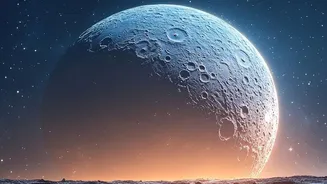
The Moon is our sky's most dynamic object, changing phase and position nightly. September 2026 features a full cycle. The month begins with a Waning Moon, leading to the last quarter on September 4th. The best time for spotting faint objects like galaxies is around the New Moon on September 11th, when the sky is darkest. The Moon then waxes, reaching its first quarter on September 18th. The main event is the Full Moon on September 26th. This full moon is known as the Harvest Moon, as it's the one closest to the autumnal equinox. Look for it to rise in the east around sunset, casting a brilliant glow.
A Parade of Bright Planets
September is a fantastic month for planet-spotting, with all five naked-eye planets making an appearance. Venus is the undisputed star of the evening, shining brilliantly in the western sky right after sunset. It reaches its peak brightness for the year on September 22nd. Saturn is also visible for most of the night, rising in the east shortly after sunset. On the night of the full moon, September 26th, Saturn will appear as a bright, star-like object shining near the lunar disk. For early risers, the pre-dawn sky offers its own rewards. Look to the east before sunrise to spot reddish Mars and the overwhelmingly bright Jupiter. On September 8th, the crescent Moon will have a stunningly close encounter with Jupiter.
Constellations to Look For
With the summer constellations still lingering and autumn patterns rising, September's sky is rich with stories. One of the most prominent sights is the Summer Triangle, an asterism formed by three bright stars: Vega, Deneb, and Altair. These stars belong to the constellations Lyra (the Harp), Cygnus (the Swan), and Aquila (the Eagle), respectively. Cygnus is particularly easy to spot as its brightest stars form a large pattern known as the Northern Cross. As the night progresses, look towards the northeast for a fuzzy patch of light. This is the Andromeda Galaxy, our closest major galactic neighbor. It's visible to the naked eye from a dark location and is a breathtaking sight in binoculars.
Shooting Stars and Other Sights
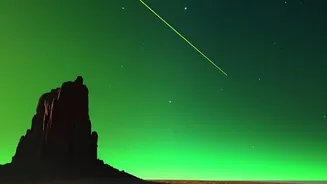
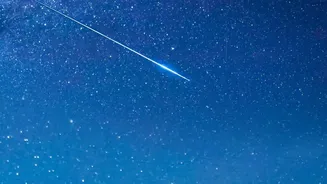
While September doesn't host any major meteor showers like the August Perseids or December Geminids, you can still catch a few shooting stars. The September Epsilon-Perseids peak around September 9th, producing a modest number of meteors. Beyond meteors, a special event occurs on September 26th when Neptune reaches opposition. This means Earth will be directly between the distant ice giant and the Sun, making it appear at its brightest and largest for the year. However, due to its immense distance, you will need a telescope to see Neptune as more than a star-like point of light.