


Our Neighbour's Puzzling Past
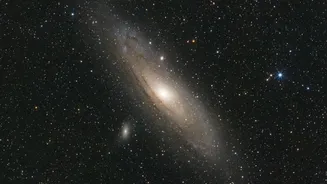
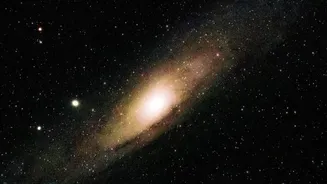
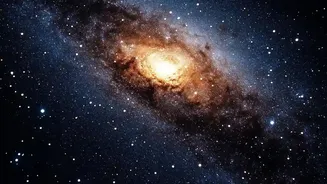
The Andromeda galaxy, also known as M31, is our closest large galactic neighbour, located a mere 2.5 million light-years away. Visible to the naked eye as a faint, fuzzy patch in the autumn sky, it is a spiral galaxy similar in size to our own Milky Way.
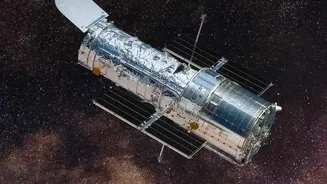
This proximity makes it a unique laboratory for astronomers. It’s close enough that the Hubble Space Telescope can resolve hundreds of millions of its individual stars, yet far enough away that we can see its overall structure—a perspective we can never get of our own galaxy from the inside. For decades, scientists have studied Andromeda to understand the life cycles of galaxies. They already knew it experienced a massive burst of star formation about two billion years ago, but its more recent history was less clear. Something had changed; the galaxy’s once-prolific star factories were slowing down, but the timeline and the reason for this cosmic deceleration remained a mystery.
The Mystery of the Starry Slowdown
A recent study published in The Astrophysical Journal has provided the clearest picture yet of this galactic evolution. An international team of astronomers, led by researchers from the University of Washington, embarked on a colossal project. They combined data from two of Hubble's most ambitious surveys of Andromeda: the Panchromatic Hubble Andromeda Treasury (PHAT) and its southern counterpart, PHAST. Together, these surveys mapped roughly two-thirds of Andromeda’s sprawling disc, creating a stellar census of about 200 million stars. The goal was to read the “fossil record” of the galaxy. By cataloging the colours and brightness of so many stars, scientists can determine their age. Massive, bright blue stars burn out quickly, indicating recent star birth, while smaller, redder stars have much longer lives, representing older populations. By analysing this data, the team could effectively turn back the clock and reconstruct Andromeda's star-making history with unprecedented detail.
Unlocking Clues in Starlight
The findings were striking. The analysis confirmed that Andromeda's star formation has been in a steady decline for the last 500 million years. Around that time, the galaxy was creating stars at a rate of about one solar mass per year, a rate similar to our Milky Way today. However, the study revealed that this slowdown accelerated dramatically in the very recent past. In just the last 40 million years, the rate of star birth has plummeted to about one-fifth of a solar mass per year. Rather than a uniform, galaxy-wide shutdown, the researchers found that most of the decline was driven by one specific feature: a huge, dusty ring of gas about 32,000 light-years from the galactic centre. This ring, which was once a hyperactive stellar nursery, has been fading in activity, dragging the galaxy's overall production rate down with it. It seems Andromeda isn't running out of fuel for new stars, but is simply taking a natural breather after a more active past.
A Galactic Collision Course
The study also investigated a long-standing suspicion: the role of M32, a small, dense satellite galaxy orbiting Andromeda. Astronomers have long wondered if a past collision with M32 could have influenced Andromeda’s structure. The new data offers a compelling clue. The team found that the region of Andromeda's disk closest to M32 experienced a more significant drop in star formation beginning around 60 million years ago. While the astronomers are careful not to draw a direct causal link, they note that M32 is the “most likely suspect” for this localized dip in star-making activity. This finding helps constrain the timeline of potential interactions between the two galaxies, adding another layer to Andromeda’s complex history. It highlights how even small galactic encounters can leave lasting impressions on their larger neighbours.