







A City Thirsty for Solutions
Mumbai's water supply system is a paradox. The city receives immense rainfall but can't store it locally. Instead, it relies on seven distant lakes that are entirely dependent on monsoon performance in their specific catchment areas. In recent years,
erratic rainfall patterns linked to climate change have seen these lake levels drop to dangerously low levels, forcing the Brihanmumbai Municipal Corporation (BMC) to impose water cuts. The city currently faces a daily water deficit of over 500 million litres per day (MLD), a gap projected to widen significantly by 2041. To secure its future, Mumbai is finally moving forward with a long-discussed plan to tap an endless resource: the sea.
The Manori Project: A Major Step
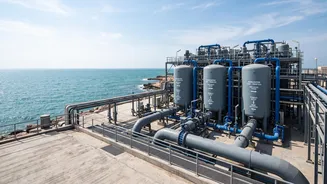
The flagship project is a major desalination plant at Manori, in the city's western suburbs. In its first phase, this facility will produce 200 MLD of potable water, with the infrastructure being built to allow for a future expansion to 400 MLD. The project will use Seawater Reverse Osmosis (SWRO) technology, a process that removes salt and impurities by pushing seawater through specialized membranes at high pressure. An Israeli firm, IDE Technologies, has been contracted to provide the core technology and operate the plant for 20 years, while an Indian company, GVPR Engineers, will handle construction. The first phase is expected to be operational by 2029, providing a much-needed, rainfall-independent water source.
Versova: The Second Front
Complementing the Manori plant, the BMC is also planning a second 200 MLD desalination facility at Versova. This project is being pursued under a different model where the civic body will not bear the upfront construction costs. Instead, a private entity will design, build, finance, and operate the plant, with the BMC purchasing the treated water at an agreed-upon rate. This approach helps the city expand its water security net without a massive initial capital outlay. While the Versova project is at an earlier planning stage compared to Manori, it signals a clear strategic shift towards a multi-pronged approach to water management.
The Cost of Water Security
Turning seawater into drinking water is neither simple nor cheap. Desalination is an energy-intensive process, and the Manori plant alone is expected to require about 45 MW of electricity. To address this, the BMC plans to power the plant with green energy, including a dedicated solar power setup. There are also significant environmental considerations, primarily the disposal of the highly concentrated salt brine that is a byproduct of the process. The BMC has been directed by environmental authorities to ensure the brine is discharged safely deep into the sea to minimize its impact on marine ecology. The high cost, estimated at over ₹11,000 crore for the Manori project including 20 years of operations, underscores that this is a premium solution for a critical problem.