






A Planet Within a Planet
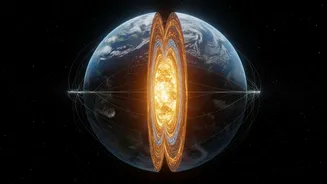
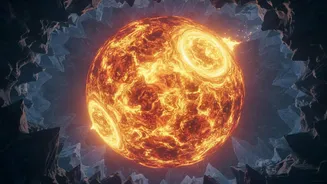
Deep in the heart of our world lies a core with two parts: a solid metal ball at the very centre, surrounded by a turbulent, liquid outer core. Composed mostly of molten iron and nickel and as hot as the surface of the sun, this outer core is a dynamic,
swirling sea of metal. This constant motion of electrically conductive liquid is not just a geological curiosity; it is the engine of our planet. The flow of this liquid iron acts like a colossal dynamo, generating the powerful magnetic field that envelops Earth, shielding us from harmful solar radiation and cosmic rays. Without this invisible force field, life on the surface would be impossible, as our atmosphere would be stripped away by the solar wind.
The Unseen River of Iron
For decades, scientists have studied the core by analysing subtle wobbles and drifts in the magnetic field measured at the surface. These observations led to a general understanding that the liquid outer core was in constant, albeit slow, motion, with a dominant large-scale flow moving westward. Think of it as a massive, slow-moving global current in this planetary ocean of iron. This model of a relatively stable, westward-drifting core was a cornerstone of geophysics for many years. But a recent discovery has challenged this view, revealing that the processes deep within our planet are far more volatile and unpredictable than previously thought.
Our Eyes in the Sky
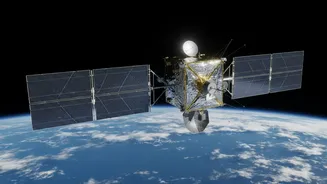
So how can we possibly know what is happening 2,900 kilometres below ground? The breakthrough comes from space. Missions like the European Space Agency's (ESA) trio of Swarm satellites, launched in 2013, are equipped with highly sensitive magnetometers that measure Earth's magnetic field with unprecedented precision. By flying in a carefully controlled formation, the satellites can untangle the magnetic signals coming from different parts of the planet—separating the signature of the core from the magnetic fields of the crust, oceans, and atmosphere. By tracking minute changes in the core's magnetic field over time, scientists can infer the speed and direction of the molten iron flowing below, essentially creating an 'X-ray' of the planet's deepest movements.
A Sudden and Mysterious Reversal
By analysing nearly three decades of data from satellites and ground observatories, scientists uncovered a startling event. Around 2010, a massive section of the core's flow deep beneath the Pacific Ocean did something completely unexpected: it reversed direction. What had been a weak westward flow slammed on the brakes and became a strong eastward current. This wasn't a subtle shift; it was a dramatic and rapid change that occurred over a few years, challenging the notion of a stable, slow-moving outer core. The reversal was so significant it has been linked to a phenomenon known as a 'geomagnetic jerk'—a sudden acceleration in the magnetic field's rate of change, which was observed in 2017.
What It Means for Our Planet
The cause of this abrupt reversal remains a mystery that scientists are now scrambling to solve. Is this a temporary wobble, part of a long-term natural cycle, or the beginning of a new, stable pattern of flow? Some researchers have hypothesised that the event is connected to changes in the rotation of the solid inner core. While this deep-Earth drama poses no immediate danger to us on the surface, understanding it is fundamentally important. The behaviour of the core dictates the behaviour of our protective magnetic shield. Knowing that such rapid and large-scale changes are possible helps scientists build better models to forecast the magnetic field's future, which is crucial for everything from satellite navigation to understanding space weather.