



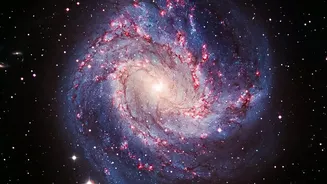
A Galaxy Knocked Off-Kilter
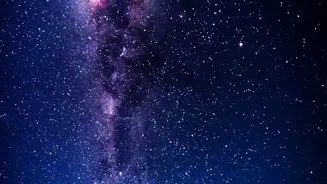
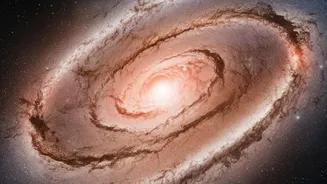
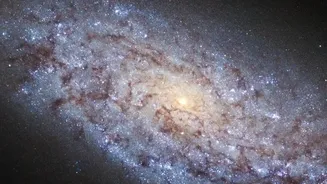
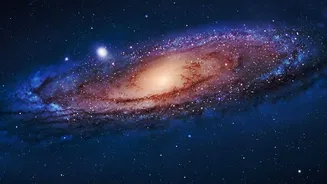
Imagine our entire galaxy, a flat disk of stars, dust, and gas, being slowly but surely tilted by more than 90 degrees. It’s a cosmic event of unimaginable scale, and astronomers now believe it likely happened to the Milky Way. This “shift sideways” refers
to the entire galactic disk reorienting itself within its much larger, spherical halo of dark matter and ancient stars. This wasn't a sudden jolt, but a gradual process that may have taken hundreds of millions of years to complete. The theory emerged from scientists trying to solve a long-standing puzzle: why the Milky Way’s stellar halo—a sparse cloud of stars surrounding the main disk—rotates far more slowly than the disk itself. The disk's stars, including our Sun, zip around the galactic center at about 220 kilometers per second, while the halo stars barely creep along at 25 kilometers per second. This discrepancy pointed to a dramatic event in our galaxy’s past.
The Ghost of a Lost Galaxy
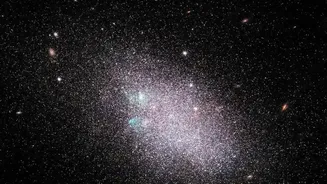
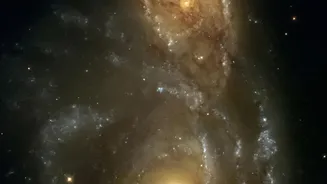
The source of this ancient violence was a head-on collision with a dwarf galaxy around 10 to 11 billion years ago. This interloper is known to astronomers as Gaia-Sausage-Enceladus (GSE), or simply the Gaia Sausage. The unusual name comes from the sausage-like shape of the orbits of its former stars, which were discovered scattered throughout the Milky Way by the European Space Agency's Gaia mission. While classified as a dwarf galaxy, the GSE was massive, containing stars, gas, and dark matter equivalent to more than 10 billion Suns. As it slammed into the young Milky Way, it was torn to shreds and its stars were absorbed, but not before delivering a gravitational blow so powerful it reshaped our galaxy's future. This collision is now considered the last major merger in the Milky Way's history and a defining moment in its evolution.
Cosmic Detective Work
Astronomers at Durham University couldn't watch this 10-billion-year-old event unfold directly. Instead, they used powerful supercomputer simulations to model the evolution of galaxies similar to our own. By running numerous simulations in a program called Auriga, they discovered a clear pattern: galaxies that had slow-rotating stellar halos, like the Milky Way, had almost always experienced two key events. First, they had undergone a major head-on merger like the one with the Gaia Sausage galaxy. Second, their main disk had performed a “flip,” tilting dramatically within its halo. The collision with the Gaia Sausage galaxy appears to have exerted a powerful gravitational torque on the Milky Way, causing the disk to gradually reorient itself over time. This provides a compelling explanation for the slow-moving halo stars, which preserve the memory of that ancient galactic upheaval.
Our Tilted Place in the Cosmos
Understanding this colossal flip does more than just solve a cosmic puzzle. It fundamentally reframes our understanding of the Milky Way’s life story, revealing a past far more turbulent and chaotic than its current serene appearance suggests. This event didn't just tilt the galaxy; it also created the central bulge and dominated the formation of the stellar halo we see today. If this flip truly happened, it means that even our own Sun and solar system once traveled on a completely different path through the galaxy before being reoriented along with the entire disk. This discovery serves as a powerful reminder that galaxies are not static islands of stars but dynamic, evolving structures shaped by violent mergers and cosmic collisions over billions of years. By studying the faint echoes of this ancient impact, we gain deeper insight into not only our own galaxy's assembly but the processes that build galaxies across the universe.