



More Than a Roll of the Dice
Traditional Indian games are more than just pastimes; they are cultural artifacts that reflect the country's rich tapestry of history, philosophy, and social values. From mentions in epics like the Mahabharata to archaeological finds in the Indus Valley,
games have been an integral part of life on the subcontinent. They were not merely for entertainment but were designed as intricate tools for teaching strategy, morality, and even cosmic order. Many were also used to strengthen community bonds, often played during festivals and family gatherings, bridging generational gaps as elders passed down rules and strategies to the young. The materials themselves, from woven cloth boards and cowrie shells to intricately hand-painted cards, transform these games into works of art.
Chaupar and Pachisi: A Royal Affair
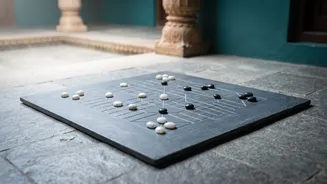
Often called the national game of India, Pachisi—and its more complex predecessor, Chaupar—has a history steeped in royalty. The most famous tale involves the 16th-century Mughal emperor Akbar, who reportedly played a life-sized version of the game at his court in Fatehpur Sikri, using courtesans as living game pieces. While Pachisi is a race game, often played with cowrie shells to determine moves, Chaupar is considered its more strategic and aristocratic cousin. It's Chaupar that is often identified as the fateful dice game in the Mahabharata, where the Pandavas lost their kingdom. These games, representing a journey to a central home square, were seen as metaphors for life and self-discovery, eventually travelling west and evolving into the simplified modern game of Ludo.
Ganjifa: The Art of the Cards
The tradition of Indian card games offers a vibrant history of its own, most notably through Ganjifa. These playing cards, which are most associated with Persia and India, are believed to have been introduced to the subcontinent by the Mughals in the early 16th century. The name itself is thought to derive from the Persian word 'ganj', meaning treasure. Initially, Mughal Ganjifa decks consisted of 96 cards across eight suits. However, the game was beautifully adapted to Indian culture, leading to the creation of the ten-suited Dashavatara Ganjifa in the 17th century. This version replaced the Mughal courtly suits with the ten incarnations of Vishnu, turning the game into a medium for celebrating Hindu mythology and art. Traditionally hand-painted and often circular, Ganjifa cards are prized as exquisite cultural artifacts.
Pallanguzhi: A Game of Sowing and Reaping
From South India, particularly Tamil Nadu, comes Pallanguzhi, a beloved variant of the global Mancala family of games. The name translates to 'many pits', and the game is played by distributing seeds—often tamarind seeds or cowrie shells—across a wooden board with two rows of pits. Pallanguzhi is a game of skill, demanding quick calculation and strategic thinking as players aim to capture the most seeds. Its origins are thought to be connected to ancient Indian Ocean trade routes, showing similarities to games from East Africa. Traditionally popular among women, it was often played during festivals. The game's mechanics, based on 'sowing' and 'harvesting' seeds, reflect the region's agrarian roots and serve as an excellent tool for honing mathematical skills.
From Gyan Chauper to Snakes and Ladders
Perhaps the most fascinating transformation of an Indian game is that of Gyan Chauper, the original version of Snakes and Ladders. Far from being a simple game of chance for children, Gyan Chauper was a profound moral and spiritual teaching tool invented as early as the 13th century, if not before. The board represented life's journey, where ladders were virtues like faith and generosity that led to higher consciousness, and snakes were vices like ego and lust that caused a spiritual downfall. The ultimate goal was not just to reach the final square, but to achieve 'Moksha' or liberation. When the game was taken to Victorian England, its deep philosophical underpinnings were stripped away, creating the simplified race game known worldwide today.