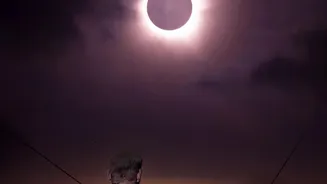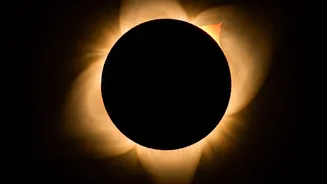









The Cosmic Drama of Rahu and Ketu
The foundation of many Hindu eclipse customs lies in a dramatic tale from the Puranas. The story goes that during the Samudra Manthan, or the churning of the cosmic ocean, the demon Svarbhanu disguised himself as a god to drink the nectar of immortality.
The sun god (Surya) and the moon god (Chandra) spotted the imposter and alerted Lord Vishnu, who swiftly beheaded the demon. But having already tasted the nectar, the head, now known as Rahu, and the body, Ketu, became immortal. In an act of eternal revenge, Rahu and Ketu are said to periodically chase and swallow the sun and moon, causing eclipses. These celestial events are thus seen as a time when the sun and moon are under attack, making the period spiritually charged and inauspicious.
The Sutak Period: A Time of Caution
The period of restriction, known as 'Sutak,' doesn't just cover the eclipse itself. For a solar eclipse (Surya Grahan), it traditionally begins 12 hours before, and for a lunar eclipse (Chandra Grahan), it starts 9 hours prior. This window is considered a time of impurity, where negative energies are thought to be on the rise. During Sutak, many devout households avoid cooking and eating. Temples close their doors, and auspicious activities are postponed. It's advised to spend the time in prayer or meditation, chanting mantras for protection. One common practice is to place leaves of Tulsi (holy basil) or blades of Darbha grass in stored food and water, believed to protect them from contamination during the eclipse.
From Fasting to Forbidden Activities
The most widely known customs involve food. Many people fast during the eclipse, consuming meals only after it ends and they have bathed. The belief is that the disturbed cosmic energies can contaminate food, making it impure. Another strong tradition involves pregnant women, who are often advised to stay indoors to protect the unborn child from supposed negative influences. Other activities like sleeping, cutting nails, or engaging in worldly tasks are also discouraged. After the eclipse concludes, a cleansing bath is considered essential to wash away any lingering impurities. This is often followed by house cleaning and acts of charity, such as donating food grains.
Science, Sight, and Safety
From a scientific viewpoint, most of these restrictions have no basis in fact. There is no evidence that food becomes unsafe to eat or that invisible rays harm pregnant women during an eclipse. The only scientifically proven danger is to one's eyesight during a solar eclipse. Staring directly at the sun, even when it is partially covered, can cause severe and permanent retinal damage, often called "eclipse blindness". The sun's intense radiation can essentially cook the retinal tissue without causing any pain, with the damage sometimes becoming apparent only hours later. This is why scientists and eye care professionals insist on using certified solar viewing glasses or indirect viewing methods to watch a solar eclipse.
A Spectrum of Belief, Not a Mandate
It's crucial to understand that these customs are not a universal, monolithic ban enforced upon all Indians. The adherence to these practices varies significantly based on family traditions, regional cultures, and personal faith. In modern India, many people navigate a middle path, watching the celestial event with protective eyewear while also respecting the traditions followed by their elders. Furthermore, the rules of Sutak traditionally only apply to regions where the eclipse is visible. If an eclipse occurs over another part of the world and cannot be seen from India, these restrictions are generally not considered applicable. This highlights that the practices are deeply tied to the visible experience of the astronomical event, rooted in a cultural and spiritual worldview.