






Bagbazar Sarbojanin: A Taste of Tradition
To understand the soul of Kolkata's community celebrations, start at Bagbazar Sarbojanin in North Kolkata. As one of the city's oldest 'sarbojanin' (for all people) pujas, it has been a cornerstone of the festival since 1919. What sets Bagbazar apart
is its unwavering commitment to tradition in an era of flashy themes. The idol here is always a classic 'ekchala' pratima, where the goddess and her children are framed within a single, beautifully decorated structure. The atmosphere is less like a modern art installation and more like a massive fair, complete with carnival rides, food stalls, and a tangible sense of community spirit that has been nurtured for over a century. Its history is also intertwined with India's freedom movement, having served as a hub for promoting 'Swadeshi' goods.
Sovabazar Rajbari: A Glimpse of Royal Heritage
For a journey back in time, visit the Sovabazar Rajbari. This ancestral home of Raja Nabakrishna Deb offers a window into the 'Bonedi Bari' (aristocratic family) pujas that predate the community festivals. Started in 1757, this celebration is steeped in history; it's said that even Robert Clive was once an invited guest after the Battle of Plassey. Unlike the public pandals, the puja here unfolds within the magnificent 'thakur dalan' (courtyard) of the old palace. The rituals are elaborate and have been preserved for generations. Many 'Bonedi Baris' like this one open their doors to the public during the festival, allowing visitors to witness a more intimate and historically rich form of worship. A visit here is not just about seeing an idol; it's about experiencing the living history of Kolkata.
South Kolkata: The Land of Themed Pandals
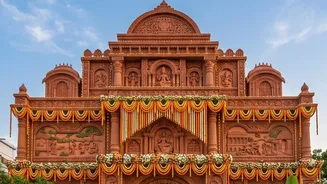
If North Kolkata is about tradition, South Kolkata is the epicentre of artistic innovation and spectacle. This part of the city is famous for its theme-based pandals, where clubs compete to create the most imaginative and elaborate structures. Pandals like Ekdalia Evergreen, Suruchi Sangha, and Chetla Agrani are titans in this arena, often recreating famous temples, crafting social commentaries, or building fantastical worlds from scratch. Ekdalia Evergreen, for instance, is known for its grand replicas of famous Indian temples, while Suruchi Sangha often picks a different Indian state as its theme each year, showcasing diverse artistry. Pandal hopping here is an adventure in itself, with massive crowds and an electric atmosphere, especially after sunset. It's a testament to the festival's evolution into one of the world's largest public art exhibitions.
College Square: Reflections of Light
A jewel in Central Kolkata's puja circuit, College Square offers a unique and mesmerising spectacle. Established in 1948, the main attraction here is the stunning reflection of the pandal and its elaborate lighting on the large adjacent lake. After dark, the entire area glows, creating a magical ambiance that draws enormous crowds and is a dream for photographers. The combination of the water, the lights, and the energy of the College Street crowd makes it an unforgettable experience. While the pandal itself is a major draw, it is this luminous waterscape that has made College Square an essential stop for generations of pandal-hoppers.
The Food Trail: A Feast for the Senses
A trip to Kolkata during Durga Puja is incomplete without indulging in its legendary street food. As you walk between pandals, the air is thick with the aroma of sizzling delights. This is the perfect time to try classics like the Kathi Roll, a flaky paratha wrapped around succulent fillings, which many consider the perfect on-the-go meal for a night of pandal hopping. Don't miss out on Phuchka, Kolkata's iconic version of pani puri, or a plate of Ghugni, a savoury yellow pea curry. For something more substantial, look for stalls selling Fish Fry, Kobiraji cutlets, or Kolkata-style Biryani. These culinary experiences are not just a sideshow; they are an integral part of the festival's fabric.