







The Man with an Impossible Dream
Robert H. Goddard was a quiet physics professor from Worcester, Massachusetts, who harbored an obsession that seemed like pure fantasy in the early 20th century: space travel. Inspired by the science fiction of authors like H.G. Wells, Goddard dedicated
his life to solving the practical problems of rocketry. While others dismissed the idea as nonsense, he spent years conducting theoretical work and self-funded research. In 1914, he secured patents for two concepts that would become fundamental to spaceflight: the liquid-fueled rocket and the multi-stage rocket. His research was often a lonely pursuit. A 1919 paper he published was ridiculed by the press, with a New York Times editorial famously—and incorrectly—stating that a rocket could not work in the vacuum of space. Stung by the public mockery, Goddard became increasingly private about his work.
A Cold Day in Auburn
The culmination of his early efforts came on March 16, 1926. On his Aunt Effie's farm in Auburn, Goddard and a small team set up a strange-looking device. The ten-foot-tall rocket, which he later nicknamed "Nell," was a contraption of thin tubes and tanks. Unusually by modern standards, the engine was mounted at the top of the rocket, with the fuel tanks for gasoline and liquid oxygen trailing below. Goddard believed this design would be more stable. At 2:30 p.m., the rocket was ignited. It rose slowly, cleared the launch frame, and shot into the air at what one observer called "express train speed." The entire flight lasted a mere 2.5 seconds. It soared to a height of 41 feet before curving over and landing in a nearby cabbage patch 184 feet away.
A Leap Nobody Noticed
The historic flight went almost completely unnoticed. There were no reporters present, only Goddard, his wife Esther, and a couple of assistants. Fearing more ridicule and wanting to protect his ideas, Goddard kept the achievement quiet for years. While a later, noisier launch in 1929 would attract unwanted attention from neighbors who thought a plane had crashed, this first crucial success remained a secret. The world did not know it, but on that cold March day, humanity had taken its first real step off the planet. Like the Wright brothers' short first flight at Kitty Hawk, this tiny, unimpressive launch proved a revolutionary concept: that a liquid-fueled rocket could provide controlled, sustained thrust.
From a Cabbage Patch to the Moon
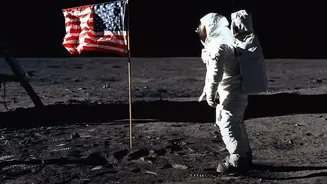
The principles demonstrated in that 2.5-second flight laid the foundation for virtually every rocket that followed. The basic technology used in Goddard's 10-pound rocket was the same that would eventually power the enormous Saturn V, the 6-million-pound vehicle that carried astronauts to the Moon. Over his career, Goddard continued to refine his designs, developing gyroscopic stabilization systems, steerable thrust, and high-speed turbopumps—all essential technologies for modern rocketry. Although he received little government support during his life, his work was closely studied elsewhere, including by German rocket scientists in the 1930s. After his death in 1945, his 214 patents became a critical blueprint for America's own space program.