



A Portrait of Galactic Drama
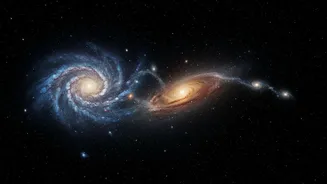
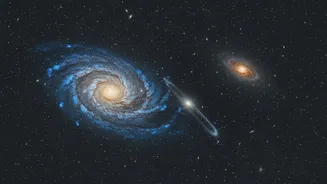
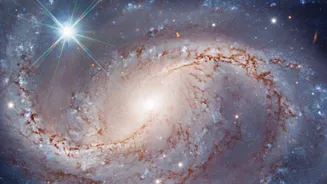
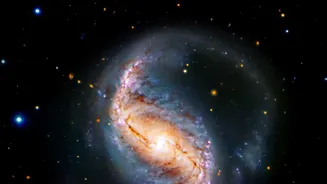
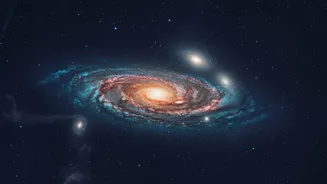
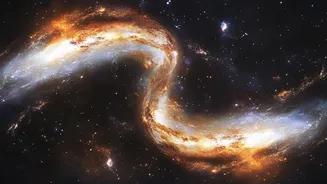
The image, captured by the Hubble Space Telescope, centres on a system known as NGC 7764A. Located about 425 million light-years away in the constellation Phoenix, it immediately draws the eye to two galaxies in the upper right. They seem to be in the midst
of a violent interaction, with long, ethereal trails of stars and gas streaming away from them. NASA's official description notes that it gives the impression they’ve been struck at high speed, like cosmic billiard balls. A third, more sedate-looking galaxy sits nearby, seemingly a part of this dramatic scene. It’s the kind of image that makes you stop and marvel at the raw power and scale of the cosmos. For years, images of galactic mergers have captivated the public, showing how these colossal structures grow by crashing into and consuming one another over hundreds of millions of years.
The Illusion of Closeness
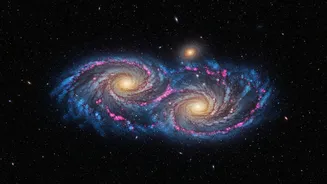
But here is where the “misleading perspective” comes in. While the two galaxies with swirling tails are indeed interacting, the status of the third is much more ambiguous. Is it part of a rare three-way tug-of-war, or is it simply an innocent bystander that happens to be in the same line of sight? Astronomers note it is so relatively close in the image that it’s possible it is interacting. However, it could also be millions of light-years in front of, or behind, the battling pair. Without a way to perceive depth, our view from Earth is fundamentally flat. This is a classic problem in astronomy. We see the universe projected onto a two-dimensional celestial sphere, and it’s easy to mistake a chance alignment for a genuine physical connection. NASA has pointed this out before with other images, such as two overlapping spiral galaxies named SDSS J115331 and LEDA 2073461, which appear to be colliding but are not actually interacting at all.
A Universe in Three Dimensions
Think of it like looking at a distant landscape. A faraway mountain peak might appear to be sitting right on top of a tree in the foreground, but you know they are separated by many kilometres. In space, without the benefit of atmospheric haze or other depth cues, making that distinction is far more difficult. All the planets in our own solar system, for example, orbit on a relatively flat plane, which is why they always appear along a line in our sky called the ecliptic. But when we look out into deep space, we see countless galaxies at vastly different distances, all superimposed on one another. An image that looks like a crowded city could actually be a very sparse town viewed from an angle that makes all the buildings line up. This is why a pretty picture is only the beginning of the scientific process.
Why Distinguishing Fact from Illusion Matters
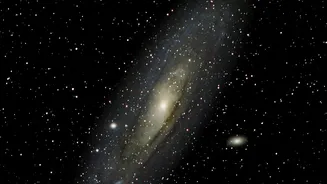
For astronomers, telling the difference between a true galactic merger and a visual coincidence is critical. Galaxy collisions are one of the primary ways that large galaxies are built. Over cosmic time, smaller galaxies merge to form behemoths like our own Milky Way, which itself is on a collision course with the Andromeda galaxy, due to merge in about 4.5 billion years. To understand this process of galaxy evolution, scientists need an accurate census of who is actually interacting with whom. They use several tools to peel back the illusion. The most important is spectroscopy, which involves breaking down the light from a galaxy into its constituent colours. This allows them to measure its redshift, which reveals how fast it is moving away from us and, therefore, its approximate distance. If two galaxies that appear close together have wildly different redshifts, astronomers know they are just a trick of perspective.