







The Celestial Drama of Rahu and Ketu
The foundation for many eclipse traditions lies in the Hindu myth of the Samudra Manthan, or the churning of the cosmic ocean. According to the legend, the gods and demons worked together to produce Amrit, the nectar of immortality. When it emerged, Lord
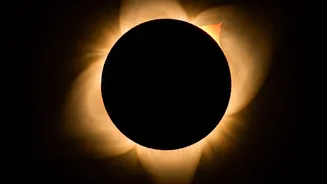
Vishnu took the form of a beautiful woman, Mohini, to distribute it only among the gods. However, a clever demon named Svarbhanu disguised himself and managed to drink a drop. The Sun (Surya) and Moon (Chandra) gods spotted him and alerted Vishnu, who swiftly beheaded the demon with his Sudarshan Chakra. Because the nectar had made his head immortal, it became Rahu, while his body became Ketu. To this day, in an act of eternal revenge, Rahu is said to swallow the sun or moon, causing an eclipse. Since Rahu has no body, the celestial body eventually re-emerges, ending the 'grahan'.
Observing the 'Sutak' Period
The inauspicious period associated with an eclipse is known as 'Sutak'. This period begins hours before the actual eclipse — typically 12 hours for a solar eclipse and 9 hours for a lunar one. During Sutak, the atmosphere is believed to be contaminated. As a result, many daily activities come to a halt. Temples close their doors, as it's believed the idols' divine energy can be disturbed by the negative energies emitted during this time. Devotees are encouraged to pause regular work and instead focus on spiritual practices like meditation and chanting mantras, as these are believed to have a magnified positive effect during an eclipse. The focus shifts from the external world to internal reflection.
What to Avoid When the Skies Darken
A list of prohibitions guides behaviour during the eclipse itself. Cooking and eating are widely avoided. Ayurvedic principles suggest that digestion slows during this period, and it is also believed that food can absorb the eclipse's negative energy. To protect stored food and water from these subtle impurities, leaves of Tulsi (holy basil) are often placed over them. Pregnant women are given special consideration and are often advised to stay indoors to shield the unborn child from potential harm. They may also be advised to avoid using sharp objects like knives, a precaution rooted in the belief that the eclipse's energies could affect the baby. Other forbidden activities include sleeping, combing hair, and engaging in sexual intercourse.
Rituals of Purification
Once the eclipse concludes and the sun or moon is 'released', a series of purification rituals begins. The first and most important is taking a bath, sometimes with clothes on, to cleanse oneself of any lingering negative energy. Homes are also purified, often by sprinkling Ganga Jal (water from the sacred river Ganges) in every room. Any food cooked before the eclipse is typically discarded, and fresh meals are prepared. Acts of charity, or 'dana', performed after an eclipse are considered highly meritorious. Many people donate food, clothing, or money to the needy to mark the return to normalcy and earn spiritual merit.
Where Astronomy and Astrology Meet
Interestingly, ancient Indian astronomers like Aryabhata gave a perfect scientific explanation for eclipses as early as the fifth century, understanding them as an alignment of celestial bodies. Yet, the mythological and astrological interpretations persist. For many Indians, there is no conflict between these two worlds. They may understand the science but still choose to observe the traditions as a matter of faith and cultural continuity. Astrophysicists and scientists continue to debunk myths, such as food becoming poisoned or the event harming pregnant women, emphasizing that an eclipse is a natural phenomenon. Despite this, the traditions surrounding a 'grahan' remain a powerful force, illustrating a unique coexistence of ancient belief and modern knowledge in contemporary India.