



A Star's Explosive Finale
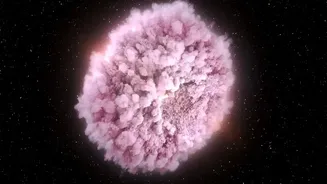
Imagine a star many times more massive than our Sun. For millions of years, it has been a cosmic furnace, fusing lighter elements into heavier ones. But eventually, it runs out of fuel. Without the outward push of nuclear fusion, gravity wins. The star's
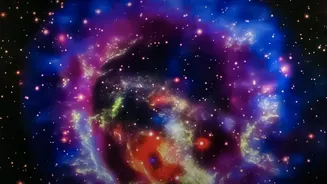
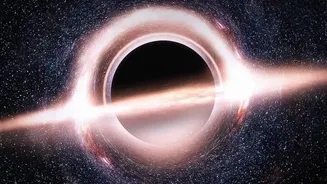
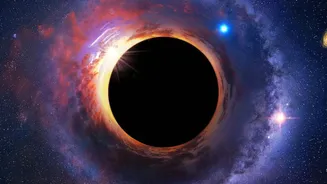
core collapses in on itself in a fraction of a second, becoming incredibly hot and dense. This catastrophic event, known as a core-collapse supernova, triggers a shockwave that blasts the star's outer layers into space. This process creates and scatters the heavy elements essential for life across the universe. But what is left behind? For a long time, scientists have worked to understand what determines if the remnant is a super-dense neutron star or an infinitely dense black hole.
Enter the Ghost Particle
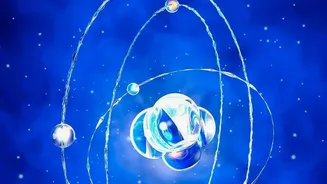
The secret may lie with the neutrino, a fundamental particle so small and weakly interacting it's often called a 'ghost particle'. Trillions of them pass through your body every second without a trace. During a supernova, the collapsing core produces an unimaginable number of neutrinos—around 10 to the power of 58. These particles carry away about 99% of the explosion's colossal energy. Although they rarely interact with other matter, the sheer quantity of them means that even a small fraction getting absorbed by the surrounding stellar material can have a huge impact. This process, called neutrino heating, is believed to be the critical push that powers the supernova explosion itself.
A Cosmic Identity Crisis
Here is where things get truly strange. Neutrinos come in three different types, or 'flavours': electron, muon, and tau. And, as confirmed by a Nobel Prize-winning discovery, they can change or 'oscillate' from one flavour to another as they travel. For years, astrophysicists assumed this flavour-swapping didn't significantly affect a supernova's outcome. However, the environment inside a dying star is so dense with neutrinos that they start interacting with each other, triggering rapid flavour changes. This is crucial because different neutrino flavours interact with the star's matter in slightly different ways. How they change type can therefore alter how much energy they deposit into the layers of the star above the core.
The Tipping Point for Black Holes
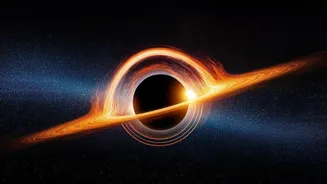
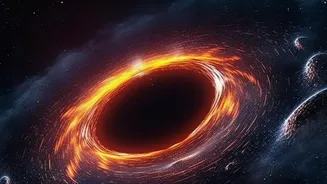
Recent computer simulations have shown that this neutrino flavour-changing can be the deciding factor between an explosion and a collapse. If the oscillations happen in a way that allows more energy to be absorbed by the star's outer layers, the shockwave gets a powerful boost, resulting in a successful supernova and leaving a neutron star. But if the flavour conversions reduce the energy transfer, the shockwave can stall and fizzle out. Without that outward push, gravity reclaims the material, causing it to fall back onto the core and pushing it past the point of no return to form a black hole. According to research published in Physical Review D, stars between 16 and 30 times the mass of the Sun are particularly sensitive to this effect.
Why This Relies on Computer Models
It's important to remember that this insight comes from complex computer modelling. We cannot directly observe the core of a star as it collapses. The processes are too fast, too small, and too extreme to witness. Scientists build sophisticated simulations based on the laws of physics—from gravity to quantum mechanics—to test their theories. These models are incredibly difficult to run, as they must account for the quantum behaviour of trillions upon trillions of particles. The recent findings come from simulations that, for the first time, coupled the hydrodynamics of the star with the quantum physics of neutrino oscillations. The results show a strong link, but they are predictions that await confirmation from future observations, such as detecting neutrinos from a nearby supernova.