


A Moon of Planetary Proportions
When we think of moons, Earth's own familiar satellite often comes to mind. But out in the cosmic neighbourhood of Jupiter, Ganymede redefines the very concept. With a diameter of about 5,270 kilometres, it is not only the largest and most massive moon in our solar
system but is also larger than the planet Mercury. If it were orbiting the sun instead of Jupiter, it would almost certainly be classified as a planet. However, being bigger doesn't mean it's heavier. Ganymede has only about 45% of Mercury's mass, a result of its composition: it's a roughly equal mix of silicate rock and water ice, making it far less dense than the small, metallic inner planet. This celestial giant was first spotted in 1610 by Galileo Galilei, who, along with his discovery of three other large Jovian moons, revolutionised our understanding of the cosmos.
The Only Moon With Its Own Magnetosphere
Perhaps Ganymede's most astonishing feature is one that can't be seen. It is the only moon in the entire solar system known to generate its own magnetic field. Discovered by the Galileo spacecraft in the 1990s, this field is created by a convecting iron core, much like Earth's. This creates a miniature magnetosphere—a bubble of magnetic influence—that is embedded within Jupiter's colossal magnetic field. This unique characteristic leads to another spectacular phenomenon: aurorae. Just like the Northern and Southern Lights on Earth, Ganymede has ribbons of glowing, electrified gas circling its poles. The interaction between its own field and Jupiter's causes these aurorae to 'rock' back and forth, a motion that has provided scientists with crucial clues about what lies beneath the surface.
A Vast, Hidden Ocean
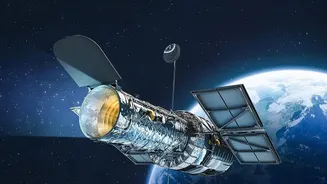
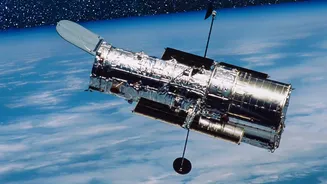
By studying the subtle rocking of Ganymede's aurorae with the Hubble Space Telescope, scientists confirmed a long-held suspicion: Ganymede has a massive subsurface saltwater ocean. This is not just a small pocket of water. It is estimated that this ocean, buried under a 150-kilometre-thick crust of ice, could be up to 100 kilometres deep and contain more water than all of Earth's oceans combined. Models even suggest a complex internal structure, like a club sandwich, with layers of liquid water stacked between different phases of ice that only exist under immense pressure. While this ocean doesn't have direct contact with a rocky mantle like on other moons—a feature considered important for the chemistry of life—its sheer scale makes Ganymede a primary target in the search for habitable environments beyond Earth.
A Tale of Two Terrains
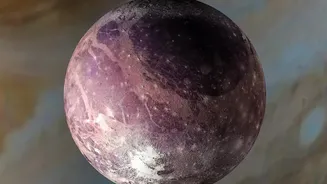
Ganymede's surface tells a complex geological story. It's a patchwork of two distinct types of terrain. About one-third of the surface consists of dark, ancient regions that are heavily pockmarked with craters, indicating they are billions of years old. The other two-thirds are covered by a lighter, younger terrain cross-crossed by intricate systems of grooves and ridges. Scientists believe this grooved terrain is the result of tectonic activity or the upwelling of water from the interior, which stretched and fractured the crust over eons. This dynamic surface, composed of about half water ice, sets it apart from purely rocky worlds and hints at a long history of geological activity.
The Future of Exploration
Our fascination with Ganymede is only growing. While missions like Pioneer, Voyager, and Galileo gave us our first detailed glimpses, a new era of exploration is underway. The European Space Agency's Jupiter Icy Moons Explorer (JUICE) mission, launched in 2023, is on its way to the Jovian system. After conducting flybys of other moons, JUICE will make history by becoming the first spacecraft to orbit a moon in the outer solar system when it enters orbit around Ganymede in the 2030s. Its goals are ambitious: to characterise the ocean, map the surface in unprecedented detail, and understand the moon's unique magnetic interactions, providing a complete picture of this potential water world.