





The Galaxy's Ghostly Halo
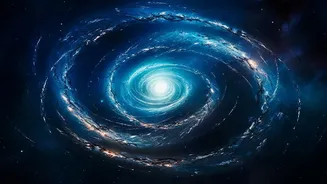
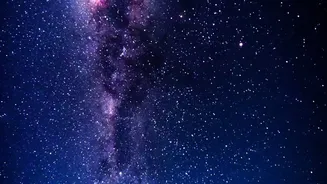
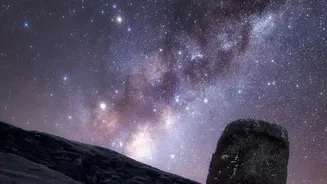
Imagine the Milky Way not just as the flat, spiraling disk we often picture, but as a bright city embedded within a vast, spherical countryside. This countryside is the stellar halo, a sparse sphere of ancient stars and globular clusters enveloping our
entire galaxy. For a long time, astronomers have studied this halo to piece together the Milky Way's formation history. Data from the European Space Agency's Gaia mission, which is meticulously mapping billions of stars, revealed a long-standing puzzle: a significant portion of the halo rotates incredibly slowly. While stars in the galactic disk, like our sun, zip around the center at roughly 220 kilometers per second, these halo stars creep along at a comparatively glacial pace, creating a mystery about their origin.
A Tale of Two Collisions
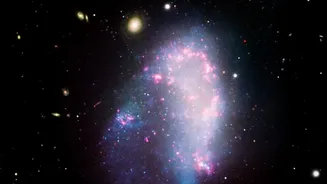
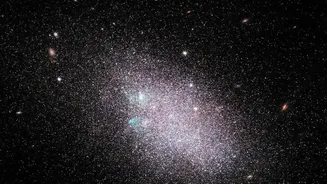
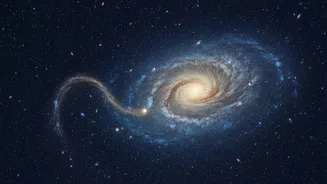
Galaxies grow by swallowing smaller ones, and the Milky Way is no exception. Its halo is filled with the shredded remains of these cosmic meals. For years, a leading theory pointed to an ancient merger with a dwarf galaxy nicknamed Gaia-Sausage-Enceladus (GSE) between 8 and 11 billion years ago as the main event that shaped our galaxy. However, another, more recent candidate has emerged: the Virgo Radial Merger, which occurred less than 3 billion years ago. Evidence for this event includes shell-like structures of stars in the constellation Virgo, which appear to be debris from a dwarf galaxy that plunged directly through the Milky Way's center. This type of head-on, or radial, collision is incredibly violent and can dramatically alter a galaxy's structure.
Did Our Galaxy Do a Flip?
Very recent research, presented in July 2026, offers a dramatic explanation connecting a head-on collision to the slow halo. Using powerful supercomputer simulations, astronomers at Durham University studied how galaxies like ours evolve after major impacts. They discovered that galaxies with slowly rotating stellar halos almost always experienced two key things: a massive head-on merger and a subsequent "disc flip," where the entire galactic disk tilted by more than 90 degrees. The collision with the Gaia-Sausage-Enceladus galaxy, believed to be the Milky Way's last major merger, fits the profile perfectly. The immense gravitational shock of this dwarf galaxy punching through our own could have been powerful enough to slowly reorient the entire Milky Way disk over hundreds of millions of years, leaving the halo with its curiously slow rotation.
Rewriting Our Cosmic History
This "disc flip" theory reshapes our understanding of the galaxy's evolution. It suggests that most of the Milky Way's stars, including potentially our own Sun, once moved on very different paths. Our supposedly stable spot in the cosmos might not have been so stable throughout the solar system's entire history. This model provides a cohesive explanation for several seemingly separate phenomena: the ancient merger, the slow stellar halo, and even the motion of the invisible dark matter halo that surrounds our galaxy. The slow rotation of the stellar halo appears to mirror the motion of the dark matter, suggesting they evolved together in the aftermath of this galaxy-altering collision. As the Gaia mission continues to release more precise data, our picture of the Milky Way's tumultuous past becomes clearer, revealing a history more dynamic and chaotic than previously imagined.