


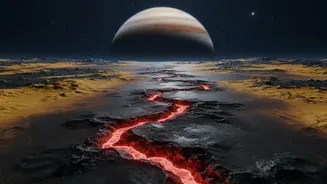
A King Among Moons
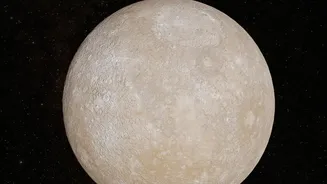
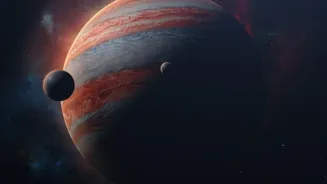
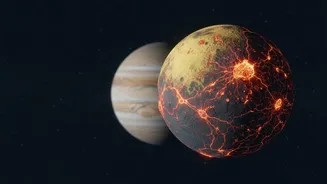
To call Ganymede large is an understatement. It is the biggest moon in our entire solar system. With a diameter of over 5,260 kilometres, it is larger than the planet Mercury and the dwarf planet Pluto. If it were orbiting the Sun instead of Jupiter,
it would almost certainly be classified as a planet. But despite its planetary scale, it is significantly less massive than Mercury. This is because Ganymede is composed of roughly equal parts silicate rock and water ice, making it far less dense than its rocky planetary cousin. This distinction is the first clue that Ganymede’s size is just the beginning of its fascinating story.
An Ocean World in Disguise
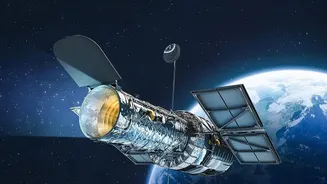
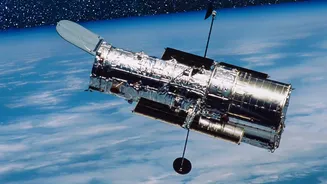
Beneath a thick crust of ice, scientists have found compelling evidence of a vast, hidden ocean. This isn't a small pocket of water, but a global saltwater ocean that may contain more water than all of Earth's surface oceans combined. Estimates suggest this ocean could be up to 100 kilometres deep, buried under an icy shell about 150 kilometres thick. The evidence for this ocean is ingenious, coming from observations of Ganymede's aurorae by the Hubble Space Telescope. The way these auroral belts rock back and forth is dampened, a phenomenon best explained by the existence of a huge, electrically conductive body of saltwater beneath the surface.
The Only Moon with a Magnetic Field
Perhaps Ganymede's most unique feature is that it is the only moon in the solar system known to generate its own magnetic field. This is a trait usually reserved for active planets like Earth. The field is believed to be generated by a dynamo effect within a churning, liquid iron core, similar to how Earth's field is created. This discovery, made by the Galileo spacecraft in the 1990s, was a major surprise, as a moon's core was expected to have cooled and solidified long ago. This tiny magnetosphere carves out its own space within Jupiter's much larger magnetic field, creating glowing aurorae near Ganymede's poles.
A Surface of Contrasts
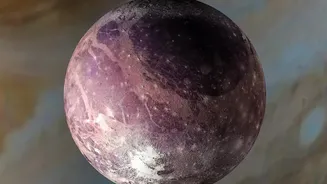
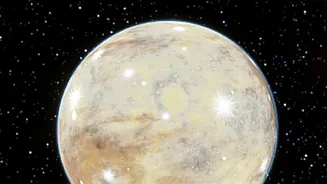
A look at Ganymede's surface reveals a world with a dynamic history. It features two distinct types of terrain. About 40% of the surface is dark and heavily cratered, indicating it is ancient, perhaps four billion years old. The other 60% is covered by a younger, lighter terrain marked by a complex system of grooves and ridges. Scientists believe this grooved terrain is the result of tectonic activity, where the moon's crust has been stretched and fractured over time, hinting at powerful internal processes. Recent flybys by NASA's Juno spacecraft in 2021 provided stunning new images of these features, revealing remnants of a deep brine that may have reached the surface.
A Target for Future Exploration
Ganymede's incredible complexity makes it a prime target for scientific investigation. The European Space Agency (ESA) launched the Jupiter Icy Moons Explorer (JUICE) mission in 2023, which is set to arrive at the Jupiter system in 2031. After performing flybys of other moons, JUICE will become the first spacecraft to ever enter into orbit around a moon other than our own when it begins circling Ganymede in late 2034. The mission aims to characterise Ganymede's ocean, analyse its unique magnetic field, and map its icy shell in unprecedented detail. These future observations promise to unlock even more secrets about this colossal and complex world.