





Who Are the Black Hole Hunters?
Black Hole Hunters is a citizen science project that invites anyone with an internet connection to become a cosmic detective. Hosted on the Zooniverse platform, the initiative empowers volunteers, with no prior astronomy degree required, to help professional
astronomers sift through vast amounts of data. The goal is to find some of the galaxy's estimated 100 million 'missing' stellar-mass black holes—the collapsed remnants of massive stars. While astronomers have identified dozens, this is a mere drop in the cosmic ocean. The project bridges the gap between the sheer volume of astronomical data and the limited number of professional researchers available to analyse it.
The Telltale Flicker of a Star
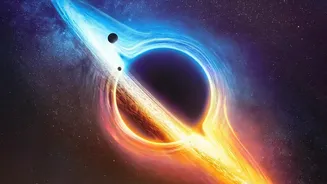
Since black holes are invisible by nature, their powerful gravity swallowing even light, hunters look for their influence on the objects around them. The project focuses on a phenomenon called gravitational microlensing. According to Einstein's theory of general relativity, massive objects warp the fabric of spacetime. If a black hole passes directly between Earth and a distant star, its gravity acts like a giant, natural magnifying glass. This 'lens' bends and focuses the star's light, causing it to appear temporarily brighter. Volunteers search for this specific signature: a sudden, symmetrical peak in a star's brightness that then fades back to normal, signalling that an invisible, massive object has passed by.
A Needle in a Cosmic Haystack
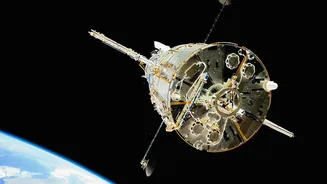
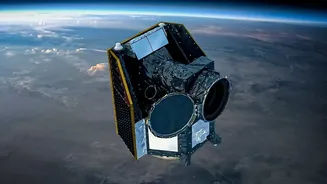
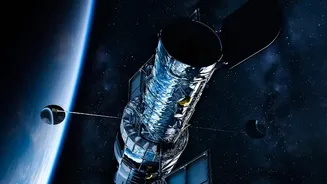
The data for this ambitious search comes from powerful telescopes like NASA's Transiting Exoplanet Survey Satellite (TESS). TESS was designed to find planets by watching for tiny dips in starlight, but its continuous monitoring of millions of stars provides the perfect dataset for finding the opposite: a sudden brightening from a microlensing event. The sheer amount of information is staggering. To narrow the search, astronomers first use artificial intelligence to scan millions of 'light curves'—graphs of stellar brightness over time—and flag about one million potential candidates. This is still far too much for a small team of scientists to review manually.
The Power of the Human Eye
This is where the citizen scientists come in. While AI is great at initial filtering, it can be easily fooled by other cosmic phenomena, such as natural stellar pulsations or flares, which can also cause a star's brightness to change. The human brain, however, is exceptionally good at pattern recognition. Volunteers are shown the pre-selected light curves and asked to identify the clean, symmetrical peak characteristic of a microlensing event. To ensure accuracy, each graph is reviewed by multiple volunteers. Their classifications are then combined, allowing scientists to build a high-confidence list of the most promising candidates that warrant follow-up observations with other telescopes.
How You Can Join the Hunt
Participating in the Black Hole Hunters project is designed to be simple and accessible. Anyone interested can visit the Zooniverse website and find the project page. Newcomers are greeted with a brief tutorial that explains exactly what to look for, showing examples of tell-tale lensing peaks versus other stellar variations. According to Dr. Adam McMaster, one of the project's leaders, every participant has a chance to contribute to a significant discovery. You don't need to be an expert; all that's required is a keen eye and a desire to explore the cosmos. By classifying light curves, volunteers make a direct contribution to cutting-edge astronomical research.